The Kosi River: Which river is called the Sorrow of Bihar? |

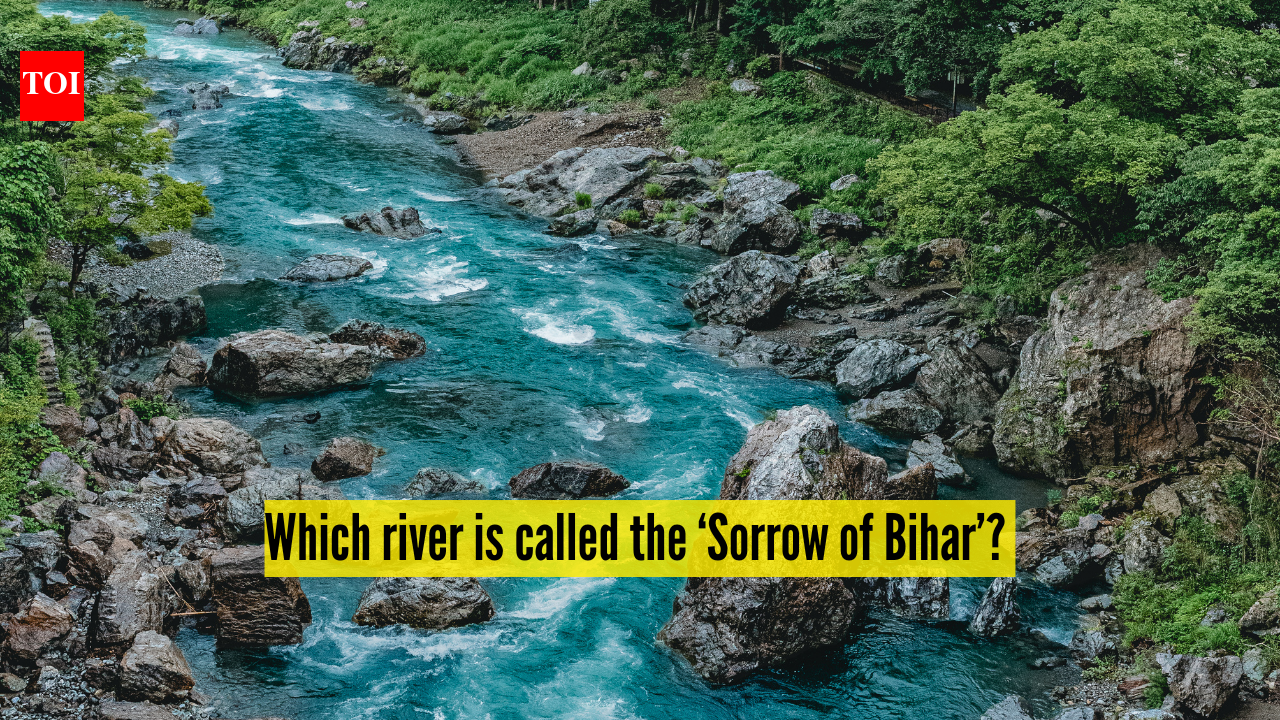
Which river is called the Sorrow of Bihar?

For centuries, rivers have been both a blessing, and in some cases, a curse. Likewise, rivers in North Bihar play a similar role. They bring fertile silt from the Himalayas, sustaining agriculture across one of India’s most densely populated rural regions. At the same time, they have repeatedly unleashed floods that erase villages, displace families and leave behind long-term economic distress. Among these rivers, one stands apart for the sheer scale and regularity of destruction it causes.Over time, this recurring destruction has earned it a sombre name rooted in experience rather than geography.That river is the Kosi River, widely known as the ‘Sorrow of Bihar.’

A river system shaped by extreme geography

The Kosi River basin is among the most complex river systems. Its catchment spans six geological and climatic belts, ranging from elevations above 8,000 m in the Tibetan Plateau to about 95 m in the Gangetic plains. Along this course, the river drains the Tibetan Plateau, the Himalayas, the Himalayan mid-hill belt, the Mahabharat Range, the Siwalik Hills and the Terai.

Dudh_Koshi_River

One of its major sub-basins, the Dudh Kosi, alone contains 36 glaciers and 296 glacier lakes, making the river highly sensitive to glacial melt and intense rainfall. The Kosi basin is bordered by several major river systems: the Tsangpo (Yarlung Tsangpo) basin to the north, the Mahananda basin to the east, the Ganges basin to the south and the Gandaki basin to the west.Read more: 10 most beautiful places in the world; India on the list

Seven rivers become one

Upstream of the Chatra Gorge, the Kosi system is fed by eight major tributaries. From east to west, these include the Tamur River in eastern Nepal, the Arun River, and the Sun Kosi, along with its northern tributaries Dudh Kosi, Likhu Khola, Tama Koshi, Bhote Koshi and Indravati. These principal rivers meet at Triveni, after which the river is known as the Sapta Koshi, meaning “Seven Rivers.” From here, it flows through the deep and narrow Chatra Gorge. This gorge exists because the Kosi is antecedent to the Himalayas, the river predates the mountain range and has cut downwards into the rising terrain over geological time instead of being diverted.After emerging from the gorge, the Sapta Koshi is regulated by the Koshi Barrage before entering the flat and vulnerable Gangetic plain.

A river of shifting channels

Below the Siwalik Hills, the river’s behaviour changes dramatically. The steep gradients of the mountains give way to flat terrain, causing the Kosi to deposit enormous amounts of sediment. Over centuries, this process has created one of the largest alluvial fans in the world, covering about 15,000 square kilometres. This alluvial fan is highly unstable. Evidence shows that the river has shifted its course more than 120 kilometres laterally over the past 250 years, using at least twelve major channels. In the 18th century, the river flowed near Purnea; today, it flows west of Saharsa. Satellite imagery also reveals abandoned channels and old confluences, including one north of Lava before 1731.Read more: Top 6 cities in India with the fastest normal passport delivery

A transboundary river with immense force

The Kosi, or Koshi, is a transboundary river flowing through China, Nepal and India. It drains the northern slopes of the Himalayas in Tibet and the southern slopes in Nepal before entering India. In Bihar, the river splits into multiple distributaries and eventually joins the Ganges near Kursela in Katihar district. By water discharge, the Kosi is the third-largest tributary of the Ganges, after the Ghaghara and the Yamuna, with an average discharge of 2,166 cubic metres per second. Each year, its floods affect around 21,000 square kilometres of fertile agricultural land, severely disrupting Bihar’s rural economy. Major Indian tributaries such as the Kamala and Bagmati, along with smaller streams like Bhutahi Balan, add to its volume and unpredictability.

The flood that reinforced its reputation
Flooded_Bihar

The river’s destructive potential was starkly evident on 18 August 2008, when it breached its embankment at Kusaha in Nepal and reoccupied an old channel it had abandoned more than a century earlier. Nearly 95% of its water flowed through this new course, inundating vast areas of Bihar and adjoining regions of Nepal About 2.7 million people were affected. Districts such as Supaul, Araria, Saharsa, Madhepura, Purnia, Katihar, Khagaria and Bhagalpur were among the worst hit. The disaster triggered one of the largest flood rescue operations in India in over 50 years, involving the Indian Army, National Disaster Response Force (NDRF), the Indian Air Force and multiple non-government organisations. The Prime Minister declared it a national calamity.

Why it is called the ‘Sorrow of Bihar’

It has been named ‘Sorrow of Bihar’ as it has been recorded that the annual floods affect fertile agricultural lands, which eventually disturb the rural economy. The term ‘Sorrow of Bihar’ reflects centuries of repeated destruction of crops, homes and livelihoods, caused by a river whose power is shaped by the highest mountains on Earth and unleashed across one of India’s most vulnerable plains.




Source link

9 easy ways to be happier and stress-free (And they’re really simple)


Every morning, grab a notebook and jot three things you’re thankful for – like your morning chai or a loved one’s smile. This isn’t silly. A 2017 fMRI study shows how gratitude journaling rewires your brain, boosts altruism and reward responses to others’ benefits after 3 weeks – evidence of brain plasticity.

Why it works: Gratitude shifts our focus from lack to abundance in our life, boosting serotonin naturally and making perspective positive. Keep it simple – no essays, just bullets. Do it over coffee. Over time, stress fades as your mindset flips to positive.


Source link

Job hugging explained: Why employees are clinging to their jobs— and what leaders can do about it |


Job hugging explained: Why employees are clinging to their jobs— and what leaders can do about it

Remember the thrill of The Great Resignation? There was a time, when professionals would quit their limiting jobs to chase dreams that felt within reach. But now? With hearts heavy, many employees are “job hugging” – which literally means gripping their roles like lifelines in a storm. It’s not love for the job; it’s raw fear. With Artificial Intelligence and technology changing the way we work, many workers are now quietly sticking to jobs which they might not even like– just for the sake of financial security.

What “Job Hugging” really feels like

Imagine this: You’re a rock climber, fingers raw on a sheer cliff, wind howling, no safety net below. That’s job hugging – a desperate hold on a stable job when the workplace feels like it’s constantly changing. Unlike job hopping’s exhilarating leaps toward better pay and purpose, this is survival mode. Employees aren’t staying because they’re inspired; they’re frozen by dread of losing a job that’s paying their bills.

The reasons for job hugging

Life’s throwing curveballs, and work feels like the one steady raft.Take economic jitters: Groceries are a nightmare – over half of Americans call them a “major stress,” per an AP poll. And so, your paycheck isn’t a dream-chaser; it’s survival.The job hunt? Brutal. The U.S. unemployment is at a four-year high, with just 22,000 jobs added in August 2025 – way under the 76,500 experts hoped for, reported Cultureamp.com. Nearly two million seekers have been hunting for over 27 weeks – that’s a quarter of the unemployed. Worker confidence? Rock bottom, says the New York Fed. Applying feels like shouting into the void.Then there’s AI, which has suddenly creeping at the workplace. A Reuters poll shows 71% of Americans dread it’ll wipe out jobs. Stanford’s research hits hard: since 2022, early-career workers in AI-hot fields saw employment drop by 13%!Even the job-hop pay bump vanished. Atlanta Fed data shows: stayers snag 4.6% raises, switchers barely edge it at 4.8%. And so, many employees are preferring to stay at the jobs instead of testing the waters and jumping at other jobs.

The Hidden Heartache for HR Leaders

Sure, retention’s up but not for a good reason. Job hugging is fear in disguise and over time it leads to career stagnation.Employees clock in, but their passion fizzles – no bold ideas, no extra mile. And the worst is when veterans block paths for eager newbies, as they fear their jobs being taken over by them.The fear of losing your job and job-hugging kills mobility, learning, and fresh projects.Job hugging also leads to silent productivity drain. And innovation freezes too: No fire, no breakthroughs. Stability is an illusion hiding a workforce treading water.

Smart Moves to Spark Joy Again

HR and managers, here are some simple steps you can take to solve the job hugging problem:Listen like family: Track moods, zoom into hurting teams and figure out what is blocking their zeal at work?Fuel growth, no big budget needed: Stretch assignments, rotations, mentors. Let your employees build skills inside, feel alive.Build that “we’re in this” vibe: Belonging is a magic for engagement. Coffee huddles, ERGs, fun events – make connections real.Talk straight, often: Share the real deal on company health. Ease fears; show their spot in the story.Arm against AI fears: Upskilling paths rebuild trust. You’re adapting. You’ve got this.

Turning Hugs into Heartfelt Commitment

Job hugging’s a symptom of scary times – stability over soul, caution over courage. But it risks a dim, disengaged world. Leaders who act with empathy flip the script: from fearful holds to joyful loves. Imagine teams buzzing, growing, innovating. That’s the win we all need.


Source link

Mrunal Thakur: Amid Dhanush wedding rumours, Mrunal Thakur turns heads in preppy skirt-and-jacket look at Lollapalooza |


Amid Dhanush wedding rumours, Mrunal Thakur turns heads in preppy skirt-and-jacket look at Lollapalooza
Amidst wedding rumours, Mrunal Thakur captivated at Lollapalooza India, proving her fashion prowess. She effortlessly donned a chic Sandro Paris ensemble featuring a navy cardigan-style jacket and a grey pleated mini skirt. Her understated accessories, including a burgundy bag and delicate jewellery, complemented her fresh makeup and soft waves, showcasing her innate style and confidence.

With wedding rumours linking her to Dhanush doing the rounds, Mrunal Thakur walked into Lollapalooza India unfazed and calmly reminded everyone why she’s first and foremost a fashion favourite. While the internet buzzed about her personal life, she kept things simple, and let her outfit steal the attention.For the music festival, Mrunal picked a look from Sandro Paris that felt cool, easy and completely her. She began with a basic white tank and layered it with a navy cardigan-style jacket, finished with neat gold buttons that added a soft touch of polish. It had structure, yes, but nothing about it felt stiff. Exactly the kind of outfit you want when you’re moving between stages, cameras and crowds.

Dhanush Sparks Fresh Dating Buzz With Mrunal Thakur After His Instagram Comment!

She teamed it with a grey pleated mini skirt, and that’s where the look really came alive. The pleats added movement, catching the light as she walked and giving the outfit a playful swing. It was preppy without being boring, feminine without trying too hard – the sweet spot, really.Accessories stayed clean and well thought out. A deep burgundy mini bag from Shop Alloya brought in a rich pop of colour and broke the neutral palette just enough. Her jewellery was delicate and low-key – tiny hoops, a fine chain, a couple of rings – proof that sometimes less really does more.

wew

Her hair and makeup followed the same easy mood. Soft waves, parted to the side, framed her face beautifully and moved naturally. Makeup was fresh and glowing – soft brows, light eyes, rosy cheeks and a muted lip that felt polished but not heavy.And those black ankle boots? Practical, stylish and perfect for a festival. They grounded the look and added just a hint of edge.With rumours swirling and headlines busy speculating, Mrunal chose to focus on what she does best – dressing well and doing it effortlessly. Calm, confident and completely at ease in her skin, she showed once again that real style doesn’t need drama.It just walks in, looks good, and owns the moment.


Source link

Nipah Virus infections: West Bengal cases prompt airport screening across Asia |


Nipah Virus infections: West Bengal cases prompt screening across these airports

Health officials have reported a number of cases of Nipah virus infection in India’s West Bengal, leading to stepped-up surveillance at airports and border crossings in parts of Asia. At the time of reporting, five cases have been confirmed and about 100 close contacts are in quarantine as part of containment measures. Several of the cases have been tied to hospital transmission, and it has raised concerns about exposure in healthcare environments.Although Nipah virus has a high case fatality rate, estimated at between 40 to 75 percent, much higher than Covid-19’s, it is currently not considered to be highly transmissible. Unlike Covid-19, Nipah is not believed to be transmitted by air. Transmission generally occurs through close contact with an infected fruit bat, consumption of contaminated food, or human-to-human transmission through respiratory droplets and body fluid exchange. This type of transmission has been reported largely in households and healthcare institutions with long-term contacts.As per World Health Organisatio, “As human-to-human transmission has been reported, in particular in health-care settings, contact and droplet precautions should be used in addition to standard precautions. Airborne precautions may be required in certain circumstances. “

airport

The virus has an incubation period which normally lasts between five and 14 days, but in some rare cases stretches to 21, a timeline that is generally similar to Covid-19. Read more: Which is the world’s largest flower and where does it grow?

Travel screenings resurface as alert widens

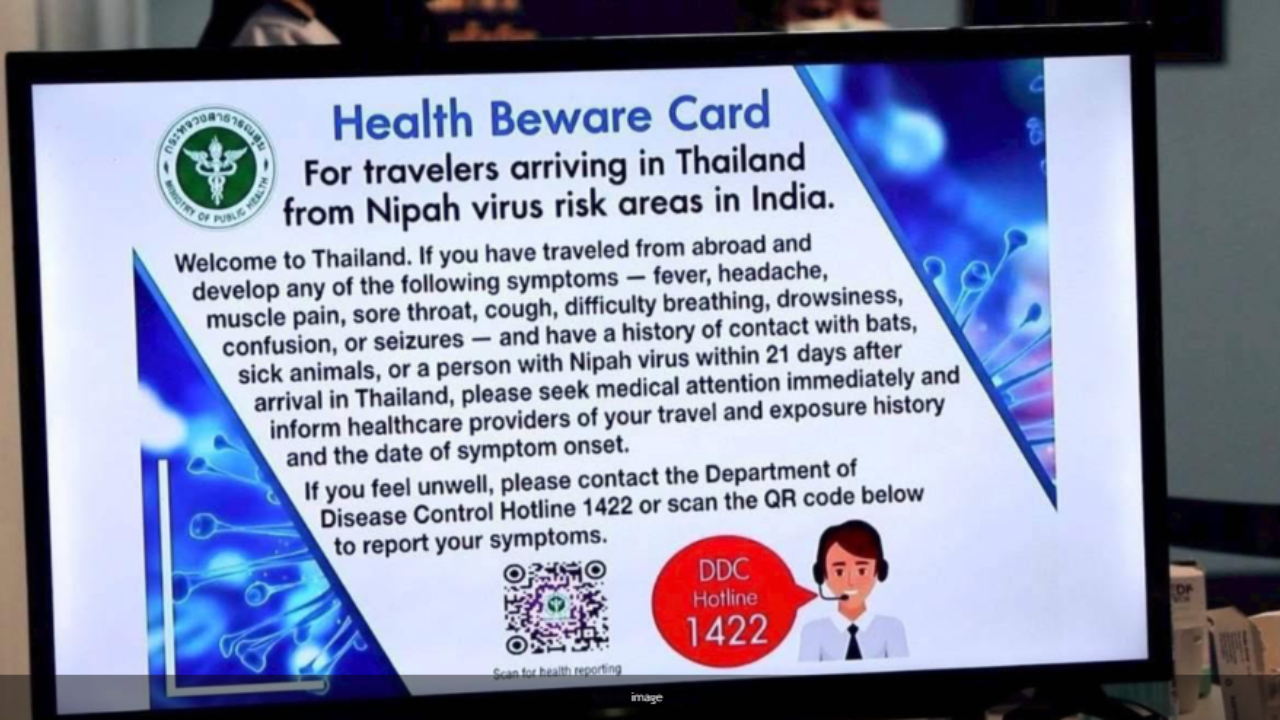
As per reports, measures such as tightened health screening and monitoring are returning to the fore as part early responses, in various parts of Asia. Thailand has begun health screenings at major airports, such as Suvarnabhumi Airport and Don Mueang International Airport and Phuket International Airport for those who are travelling from West Bengal and neighbouring areas.

thailand screening

On 25 January 2026, Thailand’s international health control checkpoints at Suvarnabhumi and Don Mueang airports started taking disease control procedures, including temperature checks and health-related documents scanning for travellers arriving from West Bengal. The screenings have gone well, the country’s Department of Disease Control said, with cooperation from passengers and the Airports of Thailand, as well as immigration authorities and other agencies.

Measures across borders

Other countries in the region are also acting on the same. Nepal has tightened entry screening at Tribhuvan International Airport and land border crossings with India to control cross-border movement, BBC reported. Also, as per a report in The Independent, Nepal, and Taiwan are among those who have taken steps like thermal screenings and health checks for passengers arriving from affected areas.

thailand screening

What is the Nipah virus?

The Nipah virus is spread from animals, especially fruit bats and pigs, to humans. It can also be transmitted by unsafe food and, in some cases, from person to person. Nipah as been placed by the World Health Organization on their list of priority diseases likely to cause outbreaks with serious public health impact.Read more: Snowfall in Kashmir disrupts air travel; all incoming and outgoing Srinagar flights cancelledThe incubation period is usually four to 14 days. Symptoms can range widely, and some people who are infected may not show symptoms. Early symptoms can include fever, headache, muscle pain, vomiting and a sore throat. In more serious cases, patients can experience diminished consciousness, drowsiness, pneumonia or encephalitis — a dangerous inflammation of the brain that can cause death. Currently, there are no approved drugs or vaccines for treatment or prophylaxis.As of last week, at least five confirmed cases had been reported in West Bengal, all traced to a private hospital in Barasat. Two of the nurses are in an intensive coronary care unit and one is still “very very” critical, local media reported, citing the state health department. So far, no cases have emerged elsewhere in the world, though precautions are spreading.


Source link

india–eu free trade agreement: what it means for travel and mobility |


India–EU Free Trade Agreement: What it means for travel and mobility

The conclusion of the India–European Union Free Trade Agreement (India–EU FTA) marks a significant shift not just in trade relations, but also in how people, professionals and businesses will move between India and Europe. Announced at the 16th India–EU Summit by Prime Minister Narendra Modi and European Commission President Ursula von der Leyen, the agreement creates a framework that is expected to directly influence business travel, professional mobility, tourism-linked services and long-term people-to-people engagement. For more clarity, check this official press release. “We did it, we delivered the mother of all deals,” European Commission President Ursula von der Leyen told reporters in Delhi, while India’s Prime Minister Narendra Modi called the deal “historic”.

Zero Tariff Access For Indian Exports As Modi Govt Seals Landmark Free Trade Deal With New Zealand

India and the European Union combined together represent roughly 25% of global GDP and around one-third of the global trade. Although the FTA is goods, services and investment-oriented, its mobility provisions are particularly important for visitors, professionals, and service suppliers travelling back and forth between both areas.One of the important aspects of this agreement with regard to travel is the future oriented mobility framework, which constitutes one of most significant parts of the agreement. The FTA will allow short-term, temporary and business visits between the two nations. This will likely help Indian professionals on short-duration trips to Europe for the purposes of short-term work in sectors such as IT and communication services, consultancy or conducting training seminars. European professionals and investors would, at the same time, be able to gain easier access to India’s growing market.

pib

The agreement further offers structured mobility for intra-corporate transferees and business visitors, as well rights of entry and work for dependants/family members where relevant. This holds true especially for such as multinational companies operating both in India and EU, with employees like executives, managers and specialists who may be required to travel across the borders for limited period. For travelers, that could mean clearer rules, less uncertainty and a better fit between immigration and trade frameworks. Besides business travel, the FTA provides opportunities for contractual service providers and independent professionals in dozens of sectors. This allows Indian professionals to visit EU member countries to deliver services under defined conditions, although only for a short period relating to a particular project. With time, this could spur demand for business travel, extended stays, and professional mobility-related tourism in key European cities.Beyond corporate travel, the FTA also opens doors for contractual service suppliers and independent professionals across dozens of sectors. These provisions allow Indian professionals to travel to EU member states to deliver services under defined conditions, supporting short-term stays linked to specific projects. Over time, this could boost demand for business travel, extended stays and professional mobility-linked tourism, particularly in major European cities.Student mobility and post-study work opportunities also form part of the broader framework. While not a visa overhaul, the agreement creates space for structured engagement on education-linked travel, academic exchange and skill development pathways. This reinforces Europe’s position as a destination for Indian students and early-career professionals, while also supporting return mobility and long-term collaboration.Indirectly, tourism-related services would also likely benefit from it. More travel related to the categories of conferences, exhibitions and professional training, as well as medical treatment and cultural exchanges will likely increase due to greater access to service areas and easier mobility.Importantly, the agreement comes alongside India’s recent trade deals with the UK and EFTA countries, effectively opening up most of Europe to Indian businesses and professionals. Together, these agreements strengthen Europe’s role as a key destination for Indian outbound travel linked to work, education and entrepreneurship, while encouraging European travel to India for investment, collaboration and tourism.


Source link

This prominent Indian airline has launched direct flights between India and Greece and travellers can’t keep calm |


This prominent Indian airline has launched direct flights between India and Greece and travellers can't keep calm

Good news for travellers planning to visit Greece from India, without jumping flights! IndiGo has officially become the first Indian airline to introduce non-stop direct flights between India and Greece. It’s a first for any Indian airline and a matter of pride. As per the airline’s official release, the services launched in January 2026 with the Airbus A321XLR aircraft. On 23 January 2026, the first Mumbai–Athens direct service began followed by the Delhi–Athens flight on 24 January. The new flights connect Mumbai’s Chhatrapati Shivaji Maharaj International Airport and Delhi’s Indira Gandhi International Airport directly to Athens International Airport (ATH) in Greece. These routes operate three times every week.With this, IndiGo has become the only Indian airline operating direct scheduled services to Greece. Now travellers can book direct flights from Delhi and Mumbai, eliminating the need to transit via Middle Eastern or other European hubs to reach Athens. These have also reduced the travel time between the two countries substantially.The announcement was also made on IndiGo’s X profile:A for Athens.Introducing a non-stop flight to #Athens from #Mumbai and #Delhi, in our all-new fleet, W.E.F. 23rd and 24th January, 2026. Fares starting at ₹21,999*. Book now: https://bit.ly/4qie1tf. #goIndiGo #NewDestination #International #GreeceWhy Greece is a must-visit destinationGreece is among Europe’s most stunning travel destinations that has been attracting globetrotters for a long time now. It is a perfect place that blends ancient history, Mediterranean beauty, and scenic landscapes. Now that there are direct Indian flights, it’s easier than ever for travellers from India to visit iconic attractions, cities and islands in Greece. On this note, let’s have a look at 5 quintessential Greek islands for first-time visitors:Santorini – Santorini needs no introduction! This is among the most famous Greek islands known for its dramatic sun views, and whitewashed buildings.Mykonos – Mykonos is where people head to when they want to party. The charming island is noted for its gorgeous beaches, lively nightlife, and luxurious resorts.Crete – Crete is the largest island in Greece. It is a perfect spot for solitude and silence seekers. The ancient ruins including Knossos are simply breathtaking. Also the Cretan cuisine is super delicious.Corfu – Then there is the gorgeous Corfu. The island is as green as it gets. The Venetian-influenced architecture are simply stunning. The island is also known for its serene beaches and historic old towns.Rhodes – Rhodes is a perfect amalgam of medieval heritage and seaside beauty. It is also home to a UNESCO-listed Old Town.The beginning of direct flights from India to Athens by IndiGo is wonderful news for the tourism industry for sure.


Source link

How to make your old glass windows shine like new; tricks that homemakers swear by |


How to make your old glass windows shine like new; tricks that homemakers swear by

Who doesn’t like a shiny, clean and crystal-clear window? It is probably the first thing we notice in a house, how clean (read sparkling clean) the window glass is. It can instantly lift the look and feel of a house allowing more light in and revealing beautiful outside views. However, most homemakers would agree that achieving a perfect glossy spotless look is not an easy task. It takes time, effort and several paper towels to achieve the shine. But if we tell you that with the right tools and techniques, you can make your glass windows gleam like they are new as if bought yesterday only. Well read on:Right toolsMicrofiber cloths: You’ll need highly absorbent microfiber cloths. Ditch paper towels.Squeegee: Find yourself a good window-cleaning squeegee. It makes a huge difference.Bucket and scrubber: For deeper cleaning with cleaning solution.2. DIY Cleaning SolutionMix equal parts white vinegar and warm water and clean your glass window. Easy solution. Or you can make a solution using a few drops of dish soap and warm water.3. Dry DustingDry dusting is the first thing. Dust away dirt and cobwebs before applying any liquid:Now, brush or vacuum clean window tracks.Now take a dry cloth and wipe screens.4. Work from top to bottomBegin with cleaning the top of the window and work your way down. Wet the glass with your DIY solution.Now take microfiber cloth and wipe in lines.Squeegee from top to bottom.5. Extra attention to specific spotsTo remove bird droppings from your window glass, first spray some warm water on the spot and leave for a few seconds. Now gently scrub with a DIY solution.To remove hard water stains, use white vinegar spray, which works wonders.For paint residue, use a plastic scraper not metal one to scratch the glass clean.6. Clean the frames and sillsSpotless glass looks even better with clean frames. Wipe down these areas with soapy water, rinse, and dry. 7. Dry for a brilliant shineOnce you are done cleaning:Use a microfiber cloth to wipe the glass.Using quick circular motions helps.You can also use crumpled newspaper for the final finish. But microfiber is considered the best choice.Regular maintenanceTo keep your windows shining, regular maintenance is necessary.If you see fingerprints or smudges, wipe clean immediately.Keep dusting frames every three-four days.So, with the right tools and DIY cleaners and a little bit of technique, you can make your glass windows shine like a new one! It’s absolutely worth it!


Source link

Bizarre! Husband divorces wife after she loses hair


Bizarre! Husband divorces wife after she loses hair

Imagine waking up one day to find your hair turning stark white overnight, then watching your entire world turn upside down because of it. That’s the painful reality for Li (the woman’s surname), a 36-year-old woman from Shangqiu in China’s Henan province. After 16 years of marriage, her husband divorced her, citing her baldness as the breaking point in the marriage for him, reported South China Morning Post (SCMP). Her story was shared on social media, and it has since then gone viral– drawing waves of sympathy for a devoted wife and mother who is now left alone. Here’s what really happened:Li shared that she poured her heart into taking care of her family – from cooking daily meals to scrubbing laundry and tending to their child. But two years ago, disaster struck. She suddenly lost a lot of hair and had large patches of white and thinning hair. When she consulted a doctor, it was diagnosed as vitiligo– a chronic autoimmune disease that strips pigment from skin, hair, and mucous membranes. Doctors say it affects 0.5-2% of people worldwide, striking without warning.This hugely transformed her appearance in the past two years; she suddenly looked decades older than her age. Neighbourhood kids were cruel, taunting her as “Qiu Qianchi,” the ghostly white-haired villain from the classic TV drama ‘The Romance of the Condor Heroes’. The mockery stung, but nothing hurt like her husband’s coldness. He did not support or accompany her in her hospital visits, refused to cover her medical bills, and skipped family gatherings (especially with her), claiming her appearance would “ruin his reputation.” Li calls him ruthless, a man she’s never known such harshness from after years of devotion.Depressed and isolated, Li turned to media for help, hoping to expose the injustice against her. After growing distance and apathy from her husband, she had no choice but to agree to the divorce which he had proposed. What’s more, the husband even won the custody of their child. Meanwhile, her husband hasn’t responded to her claims.

What causes Vitiligo?

Senior doctor Lu Manchun from Zhengzhou Leucoderma Hospital notes that vitiligo can flare anywhere on the body. Li’s case started mild on her scalp but snowballed, worsened by the very stress and anger it sparked. “A positive mindset and good mood are key to managing it,” he stresses -proving emotional well-being directly impacts physical healing.But, Li’s problem highlights deeper issues in relationships today: The stigma of visible illnesses in relationships and society. Social media users rallied with messages of support, sharing their own stories of resilience against discrimination. One wrote, “Beauty fades, but character endures—true love doesn’t bail over hair.” Vitiligo isn’t contagious or a choice; it’s a medical battle demanding empathy, not abandonment.For Li, the road ahead is lonely, but her courage in speaking out inspires. Her story reminds us: real strength blooms in vulnerability, and kindness costs nothing.What are your views on this? Tell us in the comment section below.


Source link