“A man with bloodshot eyes and a machete blocked my path…”: European traveller recounts his India trip, lists common scams to watch out for |


"A man with bloodshot eyes and a machete blocked my path...": European traveller recounts his India trip, lists common scams to watch out for

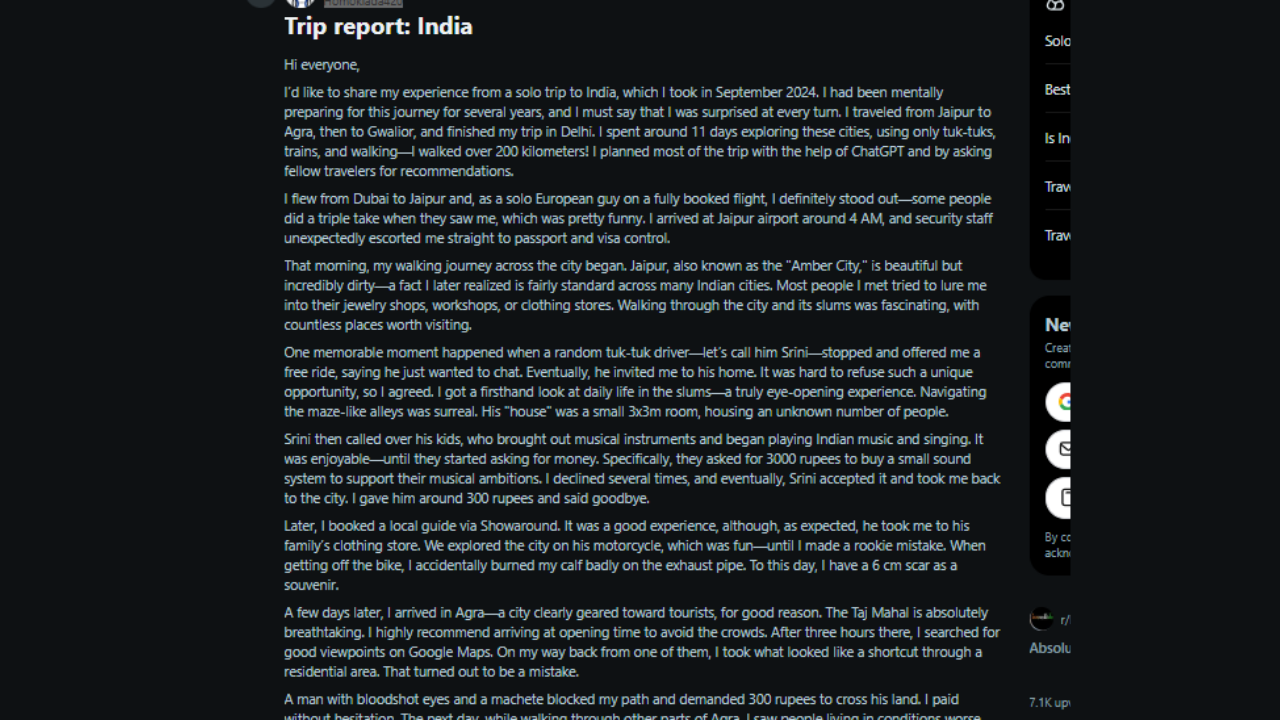
India is often described as a country that tests travellers, emotionally, physically and mentally, especially those visiting solo for the first time. From chaotic roads to stark contrasts between the rich and the poor, and then moments of unprecedented warmth and support, India can be an overwhelming and unforgettable destination for any visitor. However, for tourists across the globe, online forums are now replete with unfiltered experiences that go behind the tour itineraries for solo tourists, particularly, visiting India. One such account (Homoklada420), shared recently on Reddit, is about a European traveller who spent 11 days travelling solo across northern India in September 2024. Moving through Jaipur, Agra, Gwalior and Delhi using only public transport, tuk-tuks and long walking routes, the traveller documented everything from cultural surprises and unexpected kindness to aggressive touts, visible poverty and safety scares. What follows is his journey, and his experiences.

travel plan

The trip, he says was planned largely using ChatGPT and advice from fellow travellers, turned into a deeply personal experience that revealed not just India’s famous landmarks, but also the uncomfortable realities that guidebooks often gloss over. He says, “I flew from Dubai to Jaipur… I landed at Jaipur airport around 4 am, and to my surprise, security staff escorted me straight to passport and visa control.” He shares that his walking journey across the city began. Jaipur, also known as the Amber City, is beautiful, but incredibly dirty, which he says he later realised that it’s fairly standard across many Indian cities. Almost everyone he met tried to lure me into jewellery shops, workshops or clothing stores. Still, walking through the city and its slums was fascinating, with countless places that felt worth exploring.

India tuk tuk

One of the most memorable moments happened when he met a random tuk-tuk driver. He says, “Let’s call him Srini, who stopped and offered me a free ride, saying he just wanted to chat. Eventually, he invited me to his home. It was hard to refuse such a unique opportunity, so I agreed. I got a firsthand look at daily life in the slums. Navigating the maze-like alleys felt surreal. His house was a tiny 3×3 metre room, housing an unknown number of people.Read more: Top 10 hardest countries to get citizenship and why it’s nearly impossible Srini then called his kids over. They brought out musical instruments and started playing Indian music and singing. It was genuinely enjoyable, until they began asking for money. They wanted 3,000 rupees to buy a small sound system to support their musical ambitions. I declined several times. Eventually, Srini accepted it and took me back to the city. I gave him around 300 rupees and said goodbye.” A few days later, he arrived in Agra, a city clearly built around tourism, for good reason. The Taj Mahal is absolutely breathtaking, which he highly recommends arriving right at opening time to avoid the crowds. He shares, “After spending about three hours there, he searched for good viewpoints on Google Maps, and on his way back from one of them, I took what looked like a shortcut through a residential area. That turned out to be a mistake.Read more: Valentine’s Week Special: Famous heart-shaped destinations that are nature’s marvelsA man with bloodshot eyes and a machete blocked my path and demanded 300 rupees to cross his land. I paid without hesitation. The next day, walking through other parts of Agra, I saw people living in conditions worse than anything I’d ever witnessed, almost like animals. Tuk-tuk drivers were begging to give rides for as little as 10 rupees. In front of the Agra Fort, official guides started at 1,500 rupees and dropped to 200 by the time I walked away. It was quite a scene.”
reddit

Then came Gwalior, a beautiful and underrated city. There’s an impressive hilltop fort with several temples. He visited the Gurudwara Data Bandi Chhod Sahib, and shares that one shouldn’t hesitate to go inside, as it was a once-in-a-lifetime experience. After the visit, he was offered a simple but delicious free meal.The final five days were spent in Delhi. He adds, “I was surprised by how clean the city centre was, but beyond that, daily life looked very different. In my opinion, more than two days in Delhi isn’t necessary.”Some useful things he learned along the way:Language-wise, many people spoke fluent, understandable English. Prices vary depending on skin colour and language skills, as he was a Czech traveller, he says, “I was almost always quoted the highest price. For example, the Taj Mahal cost me 1,100 rupees, while locals paid 50.I used Uber everywhere, and for trains, the IRCTC website worked well, although verifying your account requires patience. Street food really depends on your gut, I ate it almost daily and had no issues. For the internet, I used an Airalo eSIM, which worked perfectly throughout the trip.”Common scams to watch out for include jewellery shops offering “free tours,” aggressive clothing stores, tuk-tuk or Uber drivers claiming their accounts are blocked, fake charity donations, claims that attractions are closed, overpriced official guides, fake hotel photos on websites, and overly friendly strangers, they usually have an agenda.Disclaimer: The above article is based on a Reddit post and Times of India has not verified the veracity of the claim


Source link

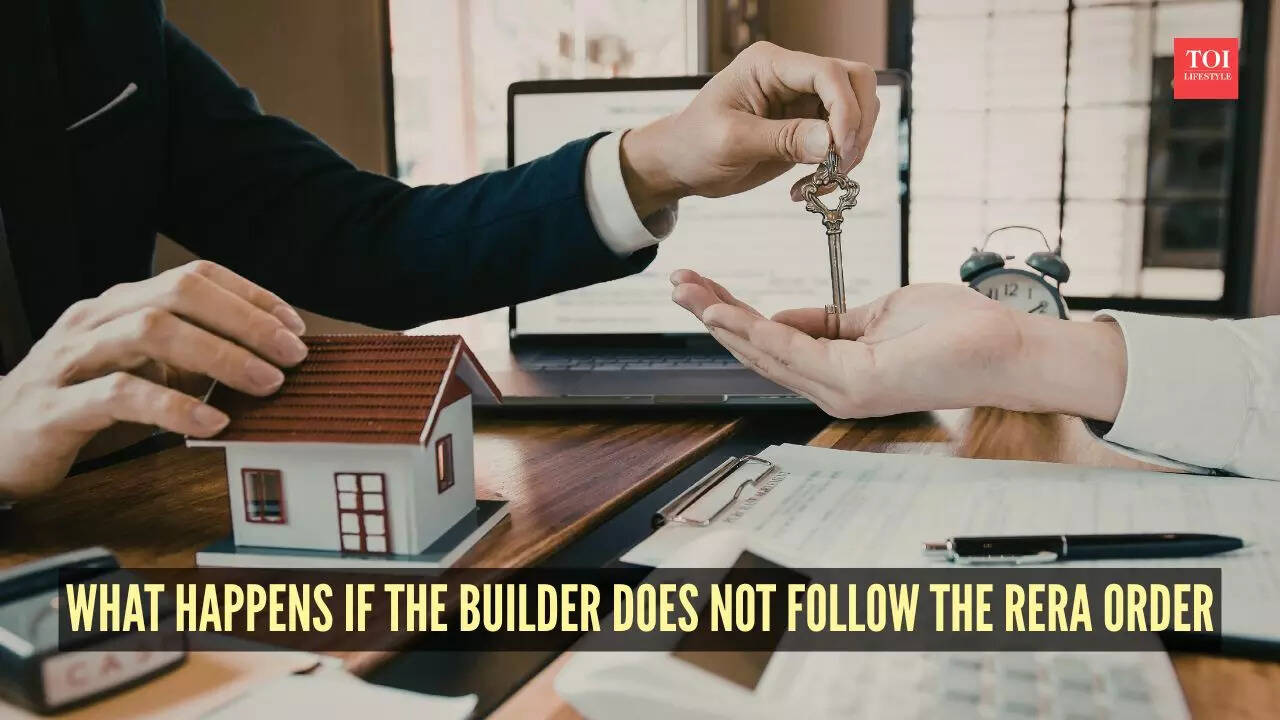
What happens if the builder does not follow the RERA order?


Authorities may require disclosure of assets, initiate seizure proceedings, escalate the case to civil courts or order civil imprisonment for continued refusal to pay compensation. In extreme situations, authorities may also restrict the builder from launching new projects or take further regulatory action.

Failure to abide by a RERA order constitutes a critical legal offense in India. Builders who fail to comply with RERA face increasing legal consequences ranging from daily monetary penalties and recovery of due payments to confiscation of assets, imprisonment, and restrictions on business activities. These stringent rules under RERA serve the very purpose of the regulation.

Image Credit: Canva


Source link

Ex-Zomato employee reveals what working there is really like, and it’s not for the faint-hearted


Ex-Zomato employee reveals what working there is really like, and it’s not for the faint-hearted
A former Zomato employee, Ragini Das, shared a heartfelt reflection on her six years at the company, highlighting how the challenging environment shaped her career and personal growth. She emphasized that Zomato’s demanding pace and high expectations fostered resilience and trust, enabling significant professional development and lasting friendships.

A former Zomato employee has posted a heartfelt note about her time at the company, and it’s struck a chord with a lot of people online. Ragini Das spent six years in Zomato’s sales and marketing team before stepping out to build her own startup, Leap Club. She’s now part of Google India, but says her Zomato years shaped how she thinks, works, and handles pressure – and also gave her friendships she still holds close.She decided to look back on her Zomato journey after founder Deepinder Goyal publicly invited former employees to consider coming back, saying the company has grown and that the door is still open. That message got Ragini reflecting on what working at Zomato really meant to her – the good, the tough, and everything in between.While her post was full of warmth, she didn’t sugarcoat the reality of the job. According to Ragini, Zomato isn’t meant to be “easy” or comfortable – and that’s kind of the whole point.“Zomato isn’t for everyone. And that’s okay,” she wrote on LinkedIn, adding that her time there helped shape the work she later did at Leap Club.She also made it clear that Zomato isn’t the place for anyone who wants a relaxed 9-to-5. The pace is relentless, expectations are high, and things move fast. But for people who thrive in that chaos, the experience can be life-changing.

Deepinder-Goyal-Success-Story

Ragini said one of the biggest things Zomato gave its employees was trust – sometimes even before they felt ready for it. If you stuck it out, the company backed you with responsibility and a belief in your potential that pushed you to grow faster than you expected.Sharing a personal example, she recalled being handed a million-dollar budget to launch a product when she was just 26. Not many companies would take that kind of bet on someone so young, she pointed out. But that trust forced you to step up and figure things out on the go.Ragini joined Zomato in 2013 as a sales and marketing manager and stayed on for six years. By the time she left in 2019, she had become the first team member of Zomato Gold in India. She also spoke about how dramatically her career evolved in that time – from trying to sell ₹3,000 banner ads at 22, to closing deals worth ₹60 lakh. Somewhere between those two numbers, she says, is where her grit was built.What stood out in her note was how much she genuinely enjoyed the grind. She joked that in six years, she probably had “Monday blues” only a handful of times. Being around people who were obsessed with what they were building made the energy contagious.Looking back, Ragini says those years at Zomato taught her how to communicate better, stay resilient under pressure, and think long-term, lessons that continue to shape the way she works today.


Source link

5 key factors that deeply impact the real estate market and what every buyer should know


Property values vary significantly depending on proximity to business hubs, transport networks, schools, and developed infrastructure. Limited land availability in well-connected urban areas often keeps prices elevated, while emerging suburbs may see slower appreciation if supply outpaces real demand. Infrastructure expansion and planning decisions therefore play a major role in long-term value.

It is important to realise that real estate markets do not behave randomly. They react to factors such as supply/demand balance, cost of borrowings, regulations, financial health of the market, and the inherent advantages of location. Analysing these factors is a much better approach to avoid investing in real estate from a purely emotional point of view.

Image Credit: Canva


Source link

“People laughed and made fun of me,” 19-year old farmer from UP shares how he fought all odds to become a model


"People laughed and made fun of me," 19-year old farmer from UP shares how he fought all odds to become a model

The son of a farmer in a small village in Aligarh, Uttar Pradesh, Nitin Kumar (Katil Model) grew up with a dream that did not fit easily into the world around him. While most boys in his village were expected to follow familiar paths, Nitin imagined himself somewhere else entirely—walking the ramp for top fashion designers, dressed in confidence and possibility.That dream, however, came at a cost.When Nitin tried practicing his ramp walk or dressing differently, he was met with ridicule. People laughed. Some mocked him openly. In a place where ambition is often measured by how closely one follows tradition, his aspiration to become a fashion model seemed strange, even unacceptable.At just 19, Nitin has already worked multiple jobs to make ends meet. One of them was as a security guard in Dwarka, Delhi. The work was grueling-12-hour shifts that left him physically and mentally exhausted.“By the end of the day, I was so tired that I had no time to think about anything else,” he recalls.

Image: Nitin Kumar

He quit the job, hoping to find opportunities in modelling, but reality soon caught up with him. He had no money to invest in portfolios, grooming, or agency registrations. Survival came first.His next job took him to the Indira Gandhi International Airport. Nitin needed money, and so he took up this job where the work was hard and the hours were long. He worked here for some time, and then came a familiar feeling of restlessness. He was afraid he would never be able to become a model.Nitin had to make a hard choice again. He quit and got a new job with a company in Noida that had an eight-hour shift and Sundays off. It wasn’t glamorous, but it gave him something valuable: time.

Image: Nitin Kumar

On his days off and in whatever free hours he could carve out, Nitin began working on himself. He searched for modelling opportunities online, practiced his walk, studied poses, and focused on building his body and confidence. There were no shortcuts—just quiet discipline and belief. However, his efforts saw no success.His father was unhappy with his choices and eventually called him back home. Nitin began helping his father in the fields, and in whatever little time he could spare, he continued to practice.“People would laugh at me and make fun of me,” he says. “Kabhi kuch nahi kar payega”, that’s what I heard from almost everyone.”What kept him going was inspiration. Models like Jeet Gurjar and Apeksha Rajput, who came from humble beginnings yet managed to carve a place for themselves in the industry, inspired him. Their journeys reminded him that where you start does not have to decide where you end.

Image: Nitin Kumar

Nitin remained undeterred. He practiced his ramp walk daily, worked on his posture and presence, and began paying close attention to his social media. Every day, he posted videos and reels, hoping someone would notice. For a long time, nothing happened. The few offers that did come his way demanded money—something he simply did not have.Eventually, he reactivated his account with a different approach. He began uploading daily vlogs, openly sharing his journey and struggles. Slowly, people started noticing the honesty in his story.His first show came in Dwarka. He was asked to pay ₹1,000 to participate—money he borrowed from a friend. He gave his best on the ramp, and it showed. The organisers called him again for another show. This time, he wasn’t asked to pay anything.From there, the progress was slow but steady. He began getting shows with small designers who did not ask for money. More importantly, he was building a portfolio—something he could never have afforded to create on his own.\

Image: Nitin Kumar

“I still have a long way to go,” Nitin says. Although he has already done shoots for brands like Amazon, ZARA and Adidas—and has been paid for his work—he knows this is only the beginning. “I want to become a supermodel. Now I know that if you stay consistent with something, you will definitely achieve it.”For a boy once told he would never amount to anything, that belief itself is a quiet but powerful victory.


Source link

Real vs fake silver: How to check silver authenticity at home through 6 easy ways |


Real vs fake silver: How to check silver authenticity at home through 6 easy ways

Silver rates have almost touched the skies with a sudden increased rate. In just weeks, prices have jumped around Rs 300 per gram and approximately Rs 3 lakh per kilogram. That’s enough to make anyone pause before buying. And it’s also enough to make fake silver far more tempting for scammers. When prices rise this fast, experts say fake silver tends to flood the market with jewellery, coins, and utensils. The good news is you don’t always need lab equipment to protect yourself. Many basic checks can be done at home. Tests that jewellers themselves often use as a first step. Here’s how you can check real silver from fake silver, without stepping outside.

How to check real and fake silver at home

This is usually the quickest test. Real silver isn’t magnetic; if the silver were real, it would not stick. If you place a small magnet on the item and it snaps into place, that’s a red flag. That said, not sticking doesn’t automatically mean it’s genuine. Some fake metals are non-magnetic too. Still, experts say this test helps rule out obvious fakes fast.Ready for the surprise? Silver conducts heat extremely well, better than almost any metal used in jewellery. Because of that, ice melts unusually fast on real silver. Place an ice cube on the item. Watch closely, and if it starts melting almost immediately, spreading water quickly, it might be genuine. If it sits there slowly, barely changing, something feels off.Checking silver by smelling may sound sounds odd, but it is the next trick one may use to detect, and it works. Real silver has no smell. None at all. If you rub the piece gently and bring it close, it should smell neutral. Fake silver sometimes gives off a coppery or metallic odour. Especially if it’s plated or mixed with cheaper metals.Rub the silver gently with a clean white cloth not aggressively. Real silver oxidises slightly and often leaves a black or greyish mark. No mark at all can mean plating or an alloy. This doesn’t damage the silver. Jewellery owners often notice this over time anyway.Silver is dense and heavier than it looks. Fill a glass with water and gently place the silver inside. Real silver sinks straight down and settles quickly. Fake silver, especially lighter alloys, sometimes moves oddly or sinks slowly. Some even float briefly before going down.This is another surprising yet interesting to check how silver can be detected through sound. Tap the silver lightly against a hard surface or another metal. Real silver makes a clear, ringing sound, almost bell-like. Fake silver sounds dull and flat.People who handle silver often recognise this instinctively. Beginners can still hear the difference with practice.

Why is it important to check the authenticity of silver

When silver prices rise this sharply, emotions come into play, and that’s exactly when people make mistakes. Experts say buyers should slow down, test and ask questions. And never rely on just one method. Real silver usually passes several checks, not just one lucky test.If something feels too cheap or rushed, it probably is. CAUTION: It may sound shinier, and that’s where the red flag is.


Source link

Why it is important to be a minimalist in today’s world and 5 things minimalists would never buy their homes |


Why it is important to be a minimalist in today's world and 5 things minimalists would never buy their homes

Minimalism never goes out of trend. It is because minimalism is not about owning nothing but is also about things that matter and has real value. At its heart, it clearly means choosing quality over quantity. It is also a kind of feeling that doesn’t allow people to do impulsive shopping. Rather than a style of fashion, it’s a state of mind and psychology of choice. On this note, let’s have a deeper look into five categories of items minimalists walk past and why you must skim them too.Decorative items that have no useUsability is the first thing a minimalist sees in an item. It’s an incredibly amazing thing and deliberate choice that they make because for them, their space is sacred. Decorative pieces that serve no purpose are useless for minimalists. Things like seasonal trinkets, and word-art signs without any emotional connection do not work for them. These items may look cute, but don’t have any real purpose. Instead, minimalists love meaningful items such as real flowers, an heirloom piece of art, or antique objects with some fascinating history. They connect with timeless and personal pieces. Single-use or specialized gadgets

Apple cutter

Canva

Single-use or specialized gadgets are a strict no-no for minimalists. They find it as a perennial trap. Kitchen gadgets such as apple slicers or egg boilers have no use in a house of minimalists. They stay away from these items. They love gadgets which they can use for real. Like they may put their money in a set of quality knives or a good set of cookware. It’s not anti-technology, it’s about versatility. They clearly don’t like clutterBooks and mediaWell, don’t get them wrong but, books (despite being beloved treasures for many!) if don’t serve purpose, don’t have a place in a minimalist house. They don’t buy books with no real intention to read them. For avid readers, alternatives include borrowing, e-readers, or buying only if they are genuinely interested in the title. Impulsive purchases Minimalism strictly avoids impulsive purchases. They also don’t go for things simply because they were on sale. For them, bargains or low price tags can be traps. While others get tempted, they slowly walk past as such purchases serve no purpose. Minimalists often enjoy simple rules and pause helps filter genuine needs from unnecessary desires.Excess mugs, throw pillows

mugs

Canva

Sometimes clutter is not created by electronics or furniture, the main culprits can be objects like mugs, throw pillows, or unnecessary seasonal decor. Minimalists often keep just a few of their favorite mugs rather than a cupboard full. They would love to have neutral throw pillows that are always useful. Minimists choose items which have purpose and usability, else they don’t. This is the best thing as they don’t like clutter. Living with less becomes not about deprivation, but about making room for what truly matters and adding value. Whether it’s time, focus or relationships, what doesn’t work, throw it out. If you’re considering becoming a minimalist, start asking yourself the question of whether it truly belongs in your life and personal space. You might find that having less doesn’t feel empty, it feels complete.


Source link

5 homemade, chemical-free ant killer sprays; effective DIY methods


Vinegar works wonders on keeping ants away. It is one magical remedy considered the most effective solution. Ants rely on scent trails to reach between food and their colonies. And that’s where vinegar works. Its strong smell breaks their trails, and makes it harder for ants to find their way. And the chain breaks!

How to make it:

All you need to do is mix equal parts white vinegar and water. You can also put a few drops of any essential oil. Pour in a spray bottle.

Spray this solution at every entry point, and in areas where ants commonly appear.

(Canva)


Source link

Why Mainpat is called the ‘Shimla’ of Chhattisgarh, and how Ulta Pani fooled gravity |


Why Mainpat is called the ‘Shimla’ of Chhattisgarh, and how Ulta Pani fooled gravity

Have you been to Chhattisgarh before? If not, here we give you reasons to plan a trip soon. Tucked away in the northern hills of Chhattisgarh, there is a small hill station, known as Mainpa, which feels strikingly different from the state’s largely forested and plateau landscapes. It lies around 55 km by road from Ambikapur, the divisional headquarters, and is often referred to as the ‘Shimla of Chhattisgarh’ or the ‘Swiss of Chhattisgarh.’ This destination is gradually emerging as a low-key alternative to India’s crowded hill towns. Perched at a higher elevation, Mainpat enjoys a cooler climate, rolling meadows, forested valleys and wide open fields that turn yellow and white during harvest season. Its relative isolation has long kept it off mainstream travel maps, but recent improvements in road connectivity and basic tourist infrastructure have begun to change that.Read more: “A man with bloodshot eyes and a machete blocked my path..” European traveller recounts his India trip, lists common scams to watch out for

The mystery of Ulta Pani (Bisar Paani)

ulta pani

Mainpat’s most talked-about attraction is Ulta Pani, also known locally as Bisar Paani. Located around 5 km before Mainpat on the Ambikapur–Mainpat road, this spot appears to defy gravity. Water in a small canal seems to flow uphill for nearly 30 ft, giving rise to decades of local curiosity, folklore and visitor fascination. For years, villagers and travellers described the phenomenon as unexplained, with no visible devices or mechanisms involved. However, academic research has since clarified the mystery. A study conducted by researchers from Ravishankar University identified Ulta Pani as a classic gravity hill, a natural optical illusion. Using Digital Elevation Modeling (DEM), the study showed that the terrain actually slopes gently downward, but the surrounding landscape and visual cues trick the human eye into perceiving an uphill flow. The findings place Ulta Pani alongside similar gravity hills found around the world, reinforcing that the effect is perceptual rather than magnetic or gravitational. Read mor: This Japan town brings the curtain down on its 10-year-old cherry blossom festival to protect the dignity of its citizens

Waterfalls, viewpoints and unusual landscapes

Besides Ulta Pani, other attractions of Mainpat that are located at different points of the plateau include Tiger Point Waterfall, Fish Point Waterfall, Ghaghi Waterfall, which get a new lease of life during and after the monsoon when water flows down the rock edges into the ravines. Viewpoints like Parpatiya provide sweeping views of the surrounding valleys, especially striking at sunrise and sunset.

waterfall

Another unique feature is Zalzali, often called the “bouncing land,” where the ground appears to move slightly underfoot due to its soft, marshy surface. While harmless, it adds to Mainpat’s reputation for unusual natural phenomena.

Tibetan settlements and cultural identity

One of the distinctive attributes of Mainpat is that it is home to the Tibetan community. One is able to visit the Buddhist temples that are dedicated to the Buddha, witness the prayer rituals, and buy woollen garments and designer mats from the Tibetan families. There are religious exiles from Tibet, and they settled in this place decades ago.This blend of tribal Chhattisgarhi culture and Tibetan heritage gives Mainpat a social landscape unlike most hill stations in central India.

Adventure and slow tourism

trek

With its open terrain and gentle slopes, Mainpat has also begun to position itself as an adventure destination. Treks, rappelling and zorbing are some of the newer additions in certain pockets, catering to the traveller seeking some adventure sans crowds. Yet, it essentially remains a destination for slow tourism — its strongest selling points are long walks, quiet drives and unhurried exploration.

How to reach Mainpat

The Sub-Divisional town is best reached by road via Ambikapur, which provides the nearest major bus terminal and rental vehicle options. Ambikapur Railway Station is the closest railhead, connecting the region to other parts of the state. In the future, air connectivity will improve. Ambikapur Airport is coming up and is proposed to connect the region with Raipur and Varanasi after flights start operating. Still largely untouched by mass tourism, Mainpat stands out not for luxury or spectacle, but for its quiet landscapes, cultural depth and natural curiosities, especially the Ulta Pani that continues to intrigue first-time visitors.


Source link

What are OC and CC in real estate and why are these important |


What are OC and CC in real estate and why are these important

Real estate is a vast sector brimming with a number of legal compliance that at times may leave first-time homebuyers confused. Among many documents that determine the legality and usability of a property, the Completion Certificate (CC) and the Occupancy Certificate (OC) stand extremely important. These certificates are issued by local municipal or development authorities to buildings that are legally constructed and are safe for living. Let’s take a closer look at these closely.Completion Certificate (CC)A Completion Certificate (CC) is issued after the construction of a building is completed. It must be done lawfully with the approved building plans, rules and regulations. This certificate confirms that the developer has followed the sanctioned layout (such as height, and zoning regulations) mentioned at the time of approval.To obtain a CC, the developer must show:Approved floor plans Approved height Safety normsFire safety Environmental and zoning regulationsParking Common area Occupancy Certificate (OC)An Occupancy Certificate (OC) is issued to a building after its completion. It means that the building is fit for occupancy. The certificate confirms that the property complies with all essential infrastructure requirements including water supply, electricity, sewage and drainage systems, among other safety requirements. The OC is a primary document as it legally permits people to live in the building. A number of states consider it illegal to live without an OC.Difference between CC and OCThe two certificates are different and serve different purposes. The one thing that’s common is that both are issued by local authorities. While the CC is the verification of the completion of the construction as per approved plans, the OC confirms that the building is safe and ready for occupation. The CC is more about the construction compliance and the OC is about the occupancy readiness of the building. Importance of CC and OC in property purchaseLegal terms: A building without a CC may be classified as unauthorised construction, while an OC is deemed illegal for occupancy. Both situations can end up in legal complications.Services: All the major services such as water connections, sewage systems, electricity and gas meters are sanctioned only after the society gets an OC.Home loans: Even to get approval for loans, one needs to show the CC and OC.Resale Value: Buyers are now cautious and avoid properties missing these certifications.So, if you are someone planning to buy a property, do not miss out on checking the Completion Certificate and Occupancy Certificate as these are fundamental documents which secure your legal standing and long-term property value. In case you ignore these certificates, you may get involved in legal issues and financial losses in the future.


Source link