Man moves back to India after 7 successful years in US, compares with life in Bengaluru; “I faced issues in…” |


Man moves back to India after 7 successful years in US, compares with life in Bengaluru; "I faced issues in..."

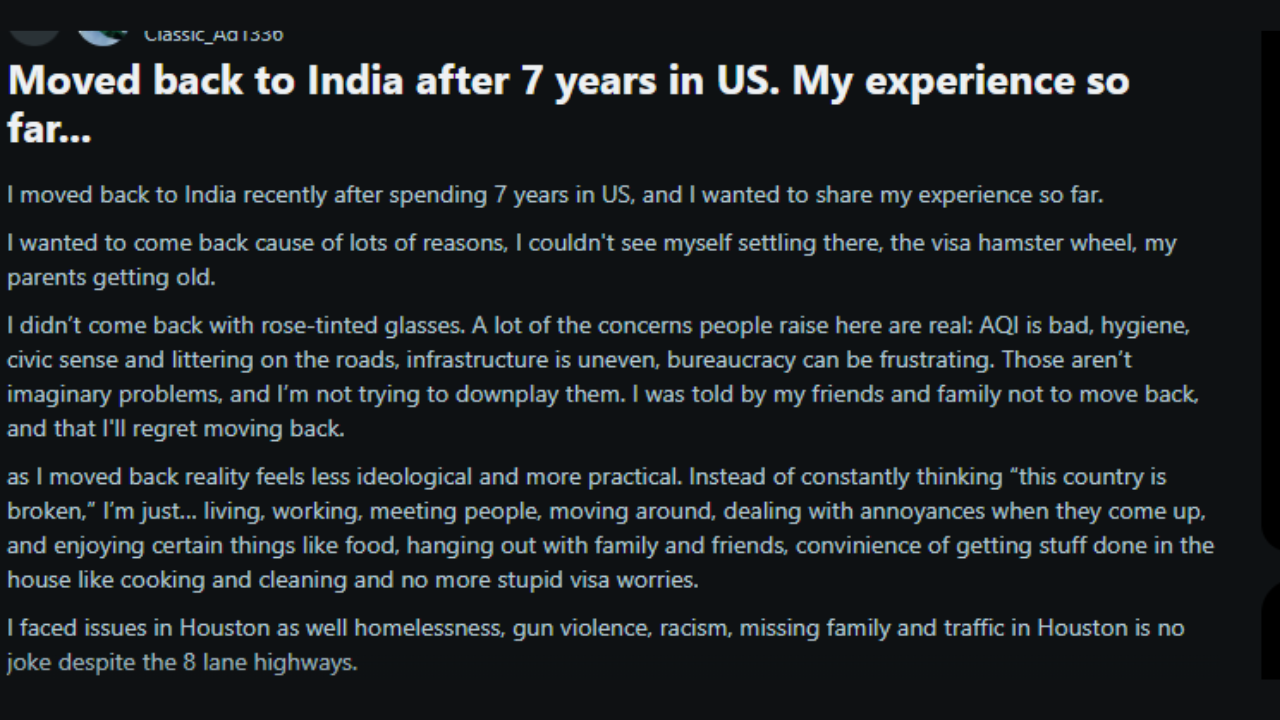
The decision to move back to India after years abroad is rarely simple. For many professionals who have spent a significant part of their adult lives in the US, the idea of returning is weighed down by fears of regression, poorer infrastructure, pollution, bureaucracy, work culture, and a perceived loss of quality of life. Online forums are filled with strong opinions on both sides, often painting the choice as a difficult one. Likewise, earlier this year, one Reddit user (Classic_Ad1336) shared his experience of moving back to India after seven years in the US, and offered a balanced note on expectations versus reality. The post, as usual, resonated with many who were indeed grappling with the same decision. He shared, “Moved back to India after 7 years in the US. My experience so far…” According to him, he wanted to come back because of lots of reasons. He shares, “I couldn’t see myself settling there, the visa hamster wheel, my parents getting old. I didn’t come back with rose-tinted glasses. A lot of the concerns people raise here are real: AQI is bad, hygiene, civic sense and littering on the roads, infrastructure is uneven, bureaucracy can be frustrating. Those aren’t imaginary problems, and I’m not trying to downplay them. I was told by my friends and family not to move back, and that I’ll regret moving back.”

road trip

Giving suggestions always seems easy, but the actual hurdle lies in implementing it in real life. He shared that as he moved back reality was far more practical. Instead of constantly thinking ‘this country is broken,’ he is going with the flow… living, working, meeting people, moving around, dealing with annoyances when they come up, and enjoying certain things like food, hanging out with family and friends, convenience of getting stuff done in the house like cooking and cleaning, with no more stupid visa worries.Well, staying abroad has both pros and cons. He pushed back against the idea that the challenges faced abroad are somehow lesser or easier to tackle. He shared, “I faced issues in Houston as well — homelessness, gun violence, racism, missing family and traffic in Houston is no joke despite the 8 lane highways. Heck I didn’t feel safe roaming there at night in certain neighborhoods. So while there as well I had to find a way to work around these issues and go on living my day to day.He agreed that he is not claiming this will be everyone’s experience, or that India doesn’t have serious issues. He was just sharing his views that for him the gap between online narratives and reality has been noticeable, in a way that he didn’t fully expect before returning.However, one thing he was sure about which is, “So far I haven’t regretted my decision of moving back and I don’t intend to go back to the US anytime soon.”
reddit

He said, “As far as work-life balance is concerned for my line of work, I haven’t noticed a meaningful difference compared to the US. Long hours and blurred boundaries exist there too…Same with traffic — congestion and stressful commutes are a reality in large US metropolitans as well… Bengaluru traffic doesn’t feel that unfamiliar or unique to me.” For all those contemplating a similar move, apart from sharing that reality an expectation can be very different, and also whether one wants to stay in the US or move back should be a personal choice, and not something driven by online narratives or general trends.People also seemed to agree with him. While agreeing with him, one shared that life is such, when you live in the US, you enjoy what it has to offer and navigate its challenges; when you live in India, it’s the same approach. No point fighting reality, study it, adapt to it, play the game according to its rules.Others also echoed the idea that constant comparison, in either direction, often leads to dissatisfaction.The discussions that happen around relocation debates, there is no objectively correct choice. There is only the choice that aligns best with one’s priorities, tolerance for uncertainty, and definition of a good life, something no online narrative can fully decide for you.




Source link

8 baby boy names that are inspired by successful celebrities


Choosing a baby boy’s name often starts with meaning and ends with emotion. Many Indian parents also look at real role models, people who built success with talent, discipline, and grit. Celebrity-inspired names work best when they feel familiar, grounded, and future-ready, not flashy. Here are eight baby boy names inspired by successful celebrities, each with a thoughtful twist that suits today’s Indian families and modern values.


Source link

Curiosity Corner: Where are some places on Earth where the sun never rises or sets |


Curiosity Corner: Where are some places on Earth where the sun never rises or sets
Earth’s tilt causes extreme light and dark periods near the poles. Places like Svalbard and Tromsø in Norway, and Utqiaġvik, Alaska, experience weeks of continuous daylight in summer and prolonged darkness in winter. Antarctica sees nearly six months of sun followed by six months of night, impacting local wildlife and human life.

Earth loves to surprise curious minds. On most days, the sun rises in the morning and sets at night. But near the very top and bottom of the planet, the sun plays by different rules. In some places, it stays in the sky for weeks or even months. In other places, it disappears for a long time. These strange and wonderful light stories happen because Earth is tilted as it travels around the sun.

Why does this happen at all?

Earth is slightly tilted, like a spinning top that leans. Because of this tilt, some parts of Earth lean toward the sun for a long time, while others lean away. Areas above the Arctic Circle in the north and below the Antarctic Circle in the south feel this the most. When these places lean toward the sun, they get the Midnight Sun. When they lean away, they get the Polar Night.

Svalbard, Norway

Svalbard sits far north, close to the North Pole. Here, the sun does not set from about late April to August. Children can play outside at midnight with the sky still bright. In winter, the opposite happens. The sun does not rise for weeks, and the land rests in deep darkness. Locals light candles and enjoy warm food to make winter feel cozy.

Tromsø, Norway

Tromsø is a lively city above the Arctic Circle. From late May to late July, the sun stays up all day and night. Birds keep singing because they think it is always daytime. In winter, the sun stays below the horizon, but the sky often glows blue or pink for a short time, like a painted picture.

Utqiaġvik, Alaska

Utqiaġvik is the northernmost town in the United States. The sun rises in mid-May and does not set again until early August. That means no bedtime darkness for about 80 days. In winter, the town goes through more than two months without sunrise. Snow, stars, and silence fill the long nights.

Frozen Giants

Parts of Greenland see weeks of nonstop daylight in summer and deep darkness in winter. Even more extreme is Antarctica. Near the South Pole, the sun stays up for almost six months, then disappears for another six months. Penguins experience one very long day and one very long night each year.

Life under endless day or night

Living without normal days and nights is not easy. Children use curtains to block light during summer so they can sleep. In winter, bright lamps help people feel cheerful. These places teach an important lesson. Nature does not look the same everywhere, and Earth has many rhythms, not just one.Disclaimer: This article is written for learning and curiosity. The timings mentioned are approximate and can change slightly each year due to Earth’s movement and location within these regions.


Source link

Quote of the day for kids: “The only limit to our realisation of tomorrow will be our doubts of today.” – Franklin D. Roosevelt |


Quote of the day for kids: "The only limit to our realisation of tomorrow will be our doubts of today." - Franklin D. Roosevelt
The insights of Franklin D. Roosevelt remind us that the convictions we hold today pave the way for the successes of tomorrow. For young minds, learning to conquer their fears is essential for cultivating their aspirations. Temporary failures can not and should not dictate their paths; rather, they serve as valuable lessons.

“The only limit to our realisation of tomorrow will be our doubts of today.” – Franklin D. Roosevelt. This quote sounds big, but its meaning is gentle and clear. It says that the future is shaped not just by talent or luck, but by belief. When doubt grows too loud, it quietly shrinks dreams. For children, this message matters deeply because childhood is the time when dreams are first formed, tested, and sometimes questioned.

What the quote really means for kids

The quote tells children that doubt can act like an invisible wall. It does not shout or stop them openly. It simply whispers, “Maybe you can’t.” When a child starts believing that whisper, effort slows down. When doubt is kept small, curiosity stays alive. The quote reminds kids that today’s thoughts decide how far tomorrow can go.

How doubt sneaks into a child’s world

Doubt often enters through small moments. A wrong answer in class. A lost race on the playground. A comparison with another child. These moments seem tiny, but they leave marks. The quote teaches that these moments should not define the future. One mistake today does not decide who a child becomes tomorrow.

The parenting link: Building belief at home

Parenting plays a quiet role here. Children borrow beliefs from adults before they build their very own. When effort is noticed more than results, doubt loses power. When children feel safe to try again, the mere fear steps back. The quote connects to parenting by reminding adults that words at home often become a child’s inner voice later.

What kids learn about failure

The quote does not say doubt will disappear forever. It teaches that doubt should not be in charge. Children learn that failure is not a stop sign. It is a signal to pause, learn, and move forward. This lesson helps children grow patient with themselves, especially when progress feels slow.

Turning doubt into questions, not fear

A takeaway for kids is this: doubt can be turned into questions. “What went wrong?” is healthier than “I can’t do this.” Questions open doors. Fear closes them. The quote quietly pushes children to stay curious instead of scared. Curiosity always gives tomorrow more room.

A lesson that grows with age

This quote stays relevant as children grow. School challenges change. Social pressures increase. Dreams become clearer and harder. The message stays the same. Belief does not promise success every time, but it promises effort. And effort always shapes a stronger tomorrow.Disclaimer: This article is meant for learning and inspiration only. It does not replace professional advice related to child development, education, or mental health. Every child grows at their own pace, and individual needs may vary.


Source link

5 things you didn’t know about Donald Trump’s viral India Gate post and the ‘Greatest Arch’ idea |


5 things you didn’t know about Donald Trump’s viral India Gate post and the ‘Greatest Arch’ idea

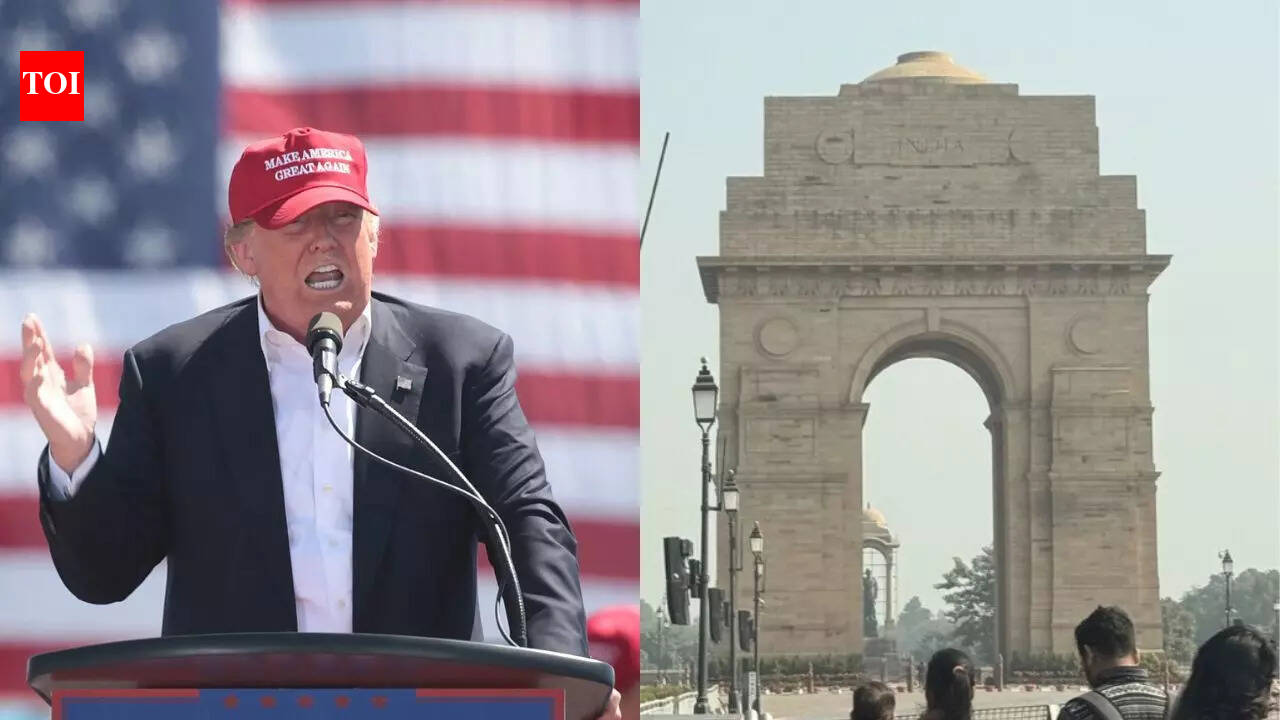
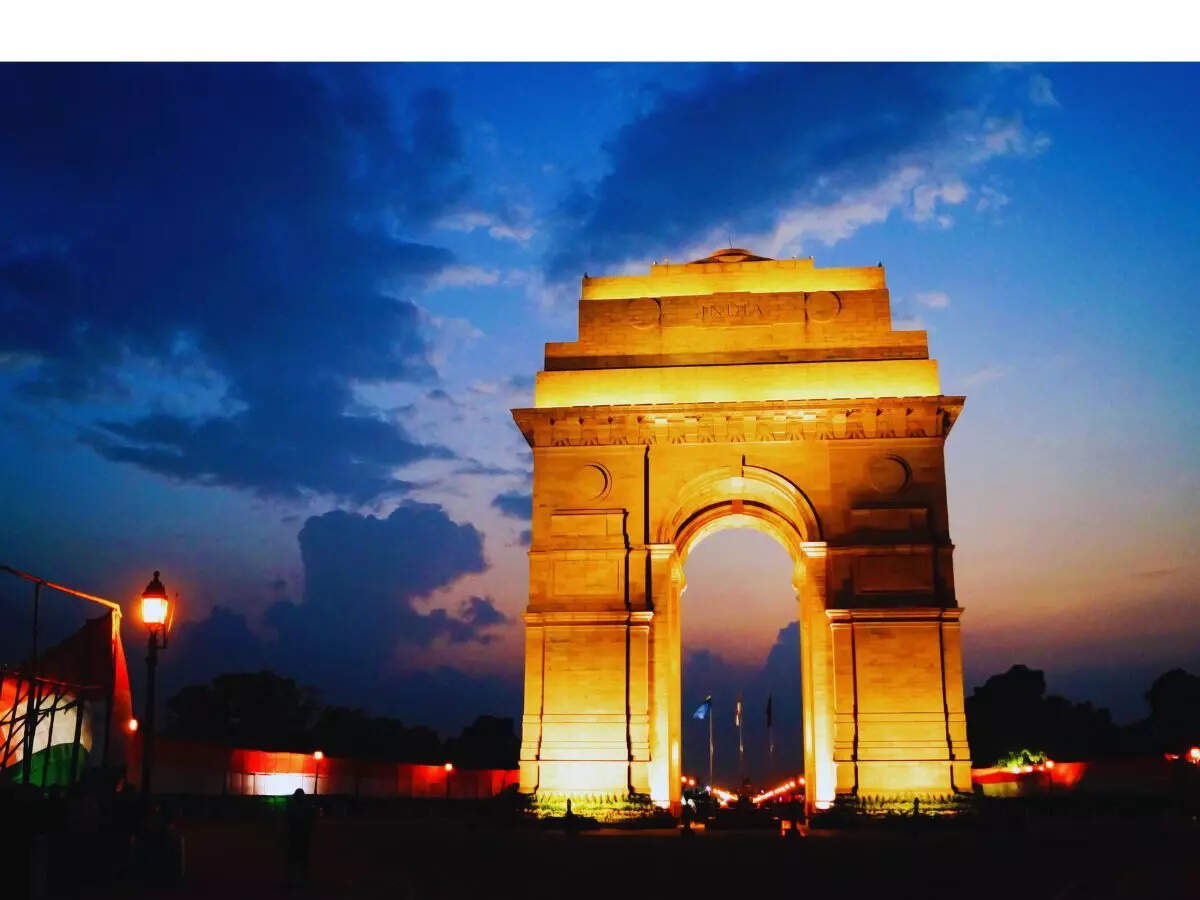
Donald J. Trump, the U.S President, recently posted a picture of DIndia’s iconic India Gate on his social media platform and called it “India’s beautiful triumphal arch” and declaring “Ours will be the greatest of them all!” For those who don’t know, India Gate is a war memorial in New Delhi and his remark was connected to his proposal to construct a mammoth triumphal arch in Washington, D.C. The post went viral in no time and soon became a subject of global curiosity.Now let’s have a look at five surprising facts you probably didn’t know about this post which is attracting mass global attention:India Gate is not just an arch; it’s a piece of history

Delhi India Gate

Canva

India Gate is an iconic architectural landmark and a war memorial designed by British architect Edwin Lutyens. It was inaugurated in 1931 and built in the memory of over 70,000 Indian soldiers who died serving the British Indian army during World War I and the Third Anglo-Afghan War. Their sacrifice is also reflected by the Amar Jawan Jyoti, the eternal flame.Washington, D.C., is among the few world capitals without a triumphal archYes, you read that right. Despite being a popular global city, there’s no triumphal arch in Washington, D.C. When Trump said “the greatest of them all,” he also meant that Washington, D.C. has no triumphal arch yet. There are some 57 cities in the world which have triumphal arches.“The Independence Arch”They are calling Trump’s envisioned monument as the “Independence Arch.” The nickname aligns with the 250th anniversary of American independence in 2026. Taller than India Gate, as per Trump’s visionAnother interesting fact is that when (if) built, it will be taller than India Gate which is around 42 meters (about 138 feet) tall. That would make it one of the tallest triumphal arches in the world. A messageBy highlighting India Gate, it is like sending a message and acknowledging India’s cultural significance. It matters because a picture along with a slogan reflect how leaders use symbolism and architecture. In this case, Trump’s reference has sparked a global debate about history, and symbolism.


Source link