3 questions to ask yourself before marrying someone


Barack credits Michelle for his triumphs – she’s his confidante, cheerleader, rock. Their story inspires: From Chicago dates to White House dances, the Obamas embodied these traits. Pfeiffer saw it firsthand too – Obama’s staff spawned tons of romances (four weddings in 2016 alone!).

Legendary investor and billionaire Warren Buffett agrees too, as he once famously said, “Marry the right person… I’m serious about that. It will make more difference in your life. It will change your aspirations, all kinds of things.”

So, ask yourself today: Does your person spark curiosity, crack you up, and share your future vision for life? These aren’t checklists; they’re lifelines to enduring love.

What qualities do you seek in a partner before deciding to marry them? Tell us in the comments below.


Source link

OpenAI CEO Sam Altman says using AI can slash prices of daily life expenses – But will it truly?


OpenAI CEO Sam Altman says using AI can slash prices of daily life expenses – But will it truly?

Imagine a world where your grocery bill shrinks, software gets dirt-cheap, and that side hustle suddenly pays like a full-time gig. OpenAI CEO Sam Altman sees this as AI’s inevitable gift— a deflationary wave crashing through the economy, making life more affordable. In recent company town halls and private chats, he’s doubled down: AI turbocharges productivity, letting one person do a team’s work, slashing costs across the board. Money would stretch further without needing fatter paychecks. It’s a sunny vision from the man steering ChatGPT’s rise, even as OpenAI burns billions quarterly while plotting $1 trillion data center empires. Exciting? Sure. Realistic? Let’s unpack.

Altman’s core pitch: Productivity unlocks abundance

Altman’s logic feels straightforward, almost hopeful. Picture software development: Today, a project needs coders, testers, managers— weeks of back-and-forth. With AI? One person ideates, iterates, and deploys in days for pennies. Multiply that by robotics, manufacturing— goods get cheaper to make, prices tumble. “Modest AI spending yields massive efficiency,” he argues, echoing past talks like a Morgan Stanley conference. Services follow: Tutors, lawyers, designers— AI handles grunt work, humans shine in creativity. Suddenly, $100 buys what once cost $200. It’s not just theory; Elon Musk and Anthropic’s Dario Amodei preach similar “post-scarcity” dreams, where basics like food and shelter cost next to nothing.OpenAI’s walking the talk, plowing cash into infrastructure despite slowing hires and ballooning ops costs. Altman shrugs off short-term pain: AI’s long game will flood markets with cheap abundance, boosting real wealth. For families pinching pennies amid inflation, it’s a tantalizing “what if”—your dollar regains power, dreams feel reachable.

The flip side: Today’s reality bites back

Here’s the reality: Dreams clash with data. US Fed rates stay put, wrestling with sticky inflation. Urban rents soar, long-term joblessness hits four-year peaks. Futurism notes studies showing AI’s productivity punch… well, missing so far. In offices, tool usage dips—workers say it doesn’t speed them up much. Hype outpaces helpings.Critics ask: If AI automates everything, then what about jobs? Altman agrees to empowerment—one-person empires thrive—but transition hurts. And history is proof of this: Tech shifts (ATMs, internet) birthed jobs, but unevenly.

What it means for the common man

Altman’s optimism stirs hope amid grocery-line gripes. Deflation sounds dreamy, but timelines matter too. While OpenAI’s trillion-dollar bet seems promising, yet quarterly fires remind us that Rome wasn’t built in a day. Leaders like Altman push a future where AI democratizes power and solo creators outpace firms. However, sceptics urge people to be cautious.Altman’s vision spotlights possibility: Tech as equalizer, not elitist toy. Will prices plummet? Jobs evolve? History says yes, but with hiccups. So stay curious— AI is rewriting rules, one prompt at a time. What’s your take— is this utopia or just hype? Tell us in the comments below.




Source link

Deepika Padukone just made a white T-shirt and jeans look 2026-level cool


Deepika Padukone just made a white T-shirt and jeans look 2026-level cool
Deepika Padukone effortlessly elevated a simple white tee and blue jeans by opting for a Zara lace-detailed top with an uneven hem. This subtle twist, paired with classic denims and soft waves, created a casually cool and stylish look. The outfit demonstrates how thoughtful details can transform basic pieces into a statement, proving that understated elegance is key.

Deepika Padukone has a real talent for making everyday clothes look quietly cool. No fuss, no drama – and yet you can’t help but notice her. That was exactly the mood when she stepped out in Mumbai recently, dressed in what looked like the most basic combo ever: a white tee and blue jeans. Simple, right? Not quite. Look a little closer and you’ll see why this outfit worked. Her T-shirt wasn’t your regular plain white number. It was a lace-detailed piece from Zara, with soft appliqué work and an uneven hem that gave it just enough edge. The round neckline and short sleeves kept things easy and wearable, but the lace brought in that extra something. It’s the kind of detail you don’t notice at first glance, and then suddenly it’s all you can see. She paired the tee with classic blue denims, rolled up at the ankles for that relaxed, off-duty feel. No overthinking here. Just a clean, easy silhouette that works for pretty much anyone. The white-and-blue combo is a forever favourite, but the lace twist makes it feel fresh for 2026. Lace is creeping back into everyday wardrobes, not just for party dresses anymore. We’ve been seeing it on runways and celebs alike, styled in a way that feels more cool-girl than costume-y. The vibe of this look was casual dinner plans, maybe a quick stop to meet friends, nothing too dressed up. And yet, it still felt styled. That’s Deepika’s sweet spot. She keeps going back to soft, neutral shades and simple shapes, and somehow always makes them feel current. There’s a quiet confidence to the way she does monochrome and muted tones, and it’s clearly sticking with her this year. Her hair did a lot of the heavy lifting too. Worn in loose, soft waves, with warm brown tones and subtle highlights, it added warmth to the crisp white tee. The contrast worked. Clean clothes, easy hair, no loud accessories. Just balanced, lived-in glamour. It’s proof that you don’t need a dramatic outfit to make a style statement. Sometimes, it’s a white T-shirt with the right little detail that does all the talking.


Source link

Curiosity Corner: Where is the waterfall that makes its own mist located? |


Curiosity Corner: Where is the waterfall that makes its own mist located?
Yosemite Falls, fondly referred to as the ‘Veil of Mist,’ enchants onlookers with its delicate spray that conjures fleeting rainbows in the air. Nestled in the breathtaking Sierra Nevada mountains of California, this majestic waterfall plunges an impressive 739 meters.

Some waterfalls roar. Some sing. One wears a soft white cloud. Yosemite Falls is often called the Fall of Mist because of the fine spray it throws into the air. When sunlight touches that spray, tiny rainbows appear. It feels like the waterfall is playing with light and air.

Which waterfall is called the Fall of Mist?

The name points to Yosemite Falls, one of the tallest waterfalls on Earth.In spring, melting snow rushes down the cliffs. The water crashes so hard that it turns into mist before touching the ground. That mist drifts like fog and cools the air around it.

Where is Yosemite Falls located?

Yosemite Falls lives inside Yosemite National Park in California, USA. The park sits in the Sierra Nevada mountains. Granite rocks, giant trees, and open skies surround the waterfall. Nature feels wide and calm here.

Why does it make so much mist?

The waterfall drops from a great height, about 739 metres (2,425 feet) in total.Water falls in three parts: Upper, Middle, and Lower Yosemite Falls. The long fall breaks water into millions of tiny drops. Those drops float as mist, especially when the flow is strong.

When does the mist appear the most?

Spring is the star season. Snow melts high in the mountains from April to June. The water rushes fast and loud. Summer slows it down. By late summer, the mist becomes light or may disappear for a while.

A small detail kids love

Stand near the lower fall on a sunny spring day. The mist can paint quick rainbows that come and go. They feel like secret smiles from the waterfall. Many visitors remember that moment long after leaving the park.

Why this name matters

“Fall of Mist” is not just a nickname. It helps notice how nature changes with seasons. The same waterfall can look wild, gentle, loud, or quiet. That lesson stays with curious minds.Disclaimer: This article is written for learning and curiosity. Natural features change with weather and seasons, so the waterfall’s look and flow may vary throughout the year.


Source link

6 everyday-use things you didn’t know you should replace regularly |


6 everyday-use things you didn’t know you should replace regularly

It is extremely important from a hygiene point of view to keep replacing your old everyday-use things regularly. While we replace our phones, phone covers and appliances without much thought, there are some household items that go completely ignored. Because of this, these things collect bacteria, or lose their effectiveness. From kitchen essentials to bedroom basics, here are some commonly-used regular items you should be replacing.1. Plastic Ice Cube Trays (Every 2 Years)No body will tell you this but you must replace your old plastic ice cube trays every two years, no kidding. Despite sitting in freezing temperatures, these trays also accumulate dirt over time. They have tiny cracks and scratches that can trap bacteria, freezer smell, and sometimes even mold. If your ice tastes weird or trays look discolored, it’s time you change the trays! 2. Reusable Water Bottles (Every 6 Months)This shouldn’t come as a surprise. Reusable bottles are eco-friendly, but they’re need to be replaced every six months. Even if you wash them daily, moisture can stay in caps or straws, making it unhygienic and they become home to a breeding ground for bacteria and mold. Plastic bottles can also degrade over time. Experts recommend replacing reusable water bottles, particularly if they’re plastic and suggest stainless steel bottles which last longer.3. Bath Towels (Every 2 Years)Change your bath towels every two years! You might be washing them regularly every other day but even after washing, they are dirty. The constant exposure to moisture makes them prone to bacterial buildup which might leave a negative effect on your skin. Change when they feel rough, or smell musty.4. Reusable Grocery Bags (Every 2 Years)You should also keep changing your reusable grocery bags every two years. These are great for reducing plastic waste, but let’s be honest, these are barely cleaned. We keep raw meat, dirty vegetables, and spills which can contaminate the fabric. This leads to bacteria growth and studies have found harmful microbes in unwashed grocery bags. So please change when it starts smelling bad looks disheveled. 5. Bed Sheets (Every 2–3 Years)While we spend half of our time in bed, we barely care to replace the sheets which are rarely replaced on schedule. We must aim at replacing our old bedsheets every two to three years. Sweat, dead skin cells, body oils, and mites build up over time, yes even if you wash regular washing. The fabric fibers weaken and sheets become less breathable. 6. Slippers (Every 8–12 Months)Then comes our slippers which we wear on a daily basis. Our house slippers absorb sweat, dust, and come into contact with bathroom floors and outdoor surfaces. Over time, they lose cushioning. So please throw them away and yourself a pair of new slippers. Worn-out slippers can also harbor bacteria and fungi. Replacing slippers every 8 to 12 months.


Source link

Benjamin Franklin: Parenting quote of the day: “Tell me and I forget, teach me and I may remember, involve me and I learn” – Benjamin Franklin |


Parenting quote of the day: “Tell me and I forget, teach me and I may remember, involve me and I learn” - Benjamin Franklin
Benjamin Franklin’s insights on education profoundly influence the art of parenting. Kids engage and learn best when they participate, rather than passively listening. This interactive method encourages accountability, boosts self-esteem, and deepens connections. Emphasizing experience over simple teaching nurtures autonomous thinkers who grasp concepts deeply, paving the way for fewer challenges ahead and establishing a stable base for their growth.

Benjamin Franklin’s quote, “Tell me and I forget, teach me and I may remember, involve me and I learn,” feels timeless because it mirrors real life at home. Children do not learn best from long talks or repeated advice. They learn when they are part of the process. In parenting, this quote reminds adults that learning sticks when children feel included, trusted, and valued.

What the quote truly means

The quote moves from passive to active learning. Being told something keeps a child on the outside. Being taught brings them a step closer. Being involved pulls them into the experience. Parenting works the same way. Rules explained once may be forgotten, but lessons lived daily leave a deeper mark.

Why involvement works better than instruction

Children’s brains learn through doing, not just listening. When a child helps cook, clean, or plan, the brain connects action with meaning. This builds stronger memory pathways. It also teaches responsibility without pressure. The lesson feels natural, not forced.

Everyday parenting moments where this shows up

Helping a sibling teaches kindness to a child more quickly than listening to a lesson. Instead of being warned about waste, a child’s financial literacy develops when they participate in creating a little budget. When kids take part in identifying emotions during peaceful times, even emotional regulation improves. Long-term behaviours are shaped by these subtle moments.

How involvement builds confidence, not fear

When children are involved, they feel capable. They learn that mistakes are part of learning, not something to fear. This builds confidence from the inside. A child who feels trusted is more likely to try again, ask questions, and think independently.

The emotional side of being involved

Involvement sends a strong emotional message: “You matter here.” Children who feel included at home often feel safer expressing thoughts outside. This emotional safety becomes the base for better communication, stronger bonds, and fewer power struggles during growing years.Busy schedules can push parents toward quick instructions. This quote asks for a pause. Slowing down and involving children may take more time today, but it saves effort tomorrow. Children who learn through involvement need fewer reminders because the lesson already lives within them.Disclaimer: This article is for general awareness and parenting insight only. It does not replace professional advice related to child development, education, or mental health. Parenting experiences may vary based on a child’s age, temperament, and environment.


Source link

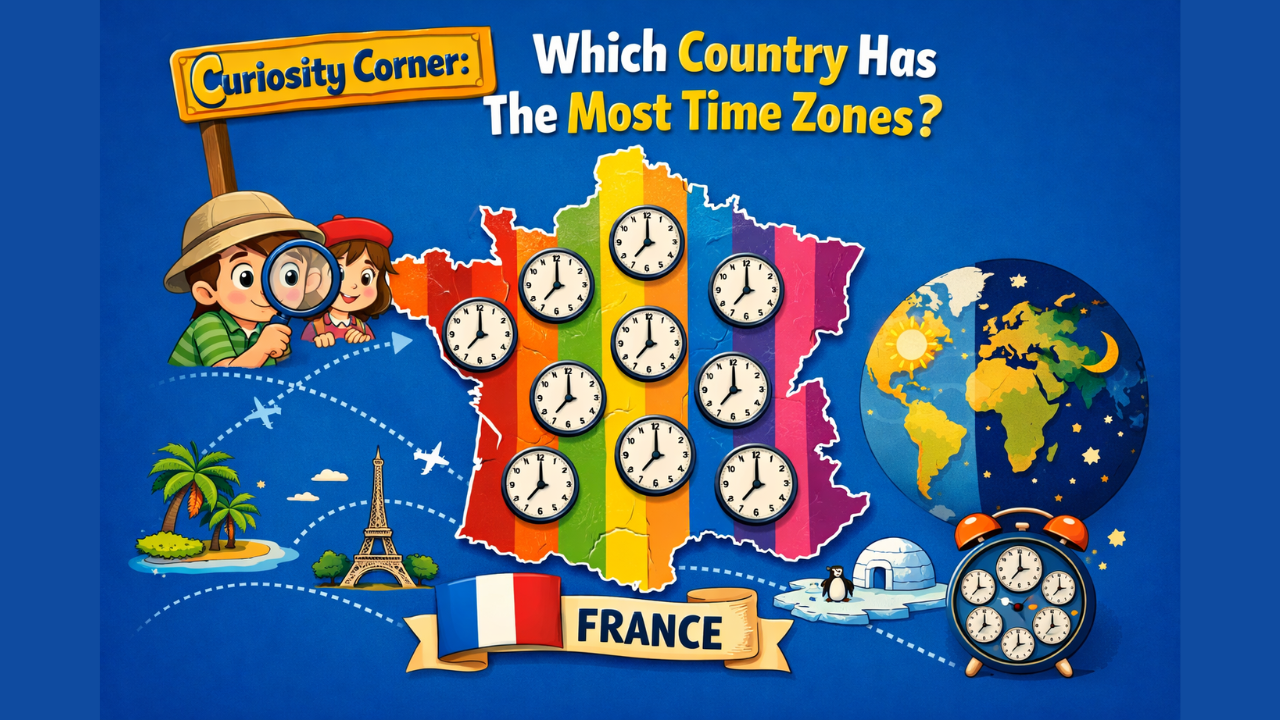
Curiosity Corner: Which country has the most time zones? |


Curiosity Corner: Which country has the most time zones?
In a fascinating twist, France boasts an impressive 12 time zones, thanks to its far-flung overseas territories. This extraordinary global footprint results in the sun rising at staggeringly different hours across its realms.

The world does not wake up at the same time. While one place eats breakfast, another is ready for bed. This happens because Earth is divided into time zones. One country surprises many kids and adults by having more time zones than any other.

The surprising winner

France holds the record for the most time zones in the world. This count includes its overseas territories. Altogether, France has 12 different time zones, more than even very large countries.

France

Why does France have so many clocks

France is not only the country seen on a Europe map. It also has islands and lands spread across oceans. These places are far apart, so the sun rises at very different times. Each place needs its own clock.

A quick island tour

Some French lands sit in the Caribbean Sea, near South America. Others lie in the Indian Ocean, close to Africa. A few are tiny islands in the Pacific Ocean. Each area adds one more time zone to France’s list.

How does this help kids understand time

Imagine a classroom project calling friends from different French islands. One child might be in school, while another is eating dinner. This shows how time zones help people live by the sun, not by one rule.

A fun fact to remember

Russia and the United States are very big countries. Still, they have fewer time zones than France when overseas lands are counted. Size alone does not decide the number of clocks.This fact teaches that countries can be connected in many ways, not just by land. Even faraway islands can share the same flag and laws, while living in different times of day.Disclaimer: This article is written for learning and curiosity. The information is based on widely accepted geographical facts about time zones and overseas territories.


Source link

Ladakh’s sky turned blood-red. It wasn’t just beautiful – it was a warning |


Ladakh’s sky turned blood-red. It wasn’t just beautiful - it was a warning
A powerful solar radiation storm, the most intense since 2003, caused a rare red aurora over Hanle, Ladakh. This event, triggered by an X-class solar flare and Coronal Mass Ejection, highlighted Earth’s vulnerability to solar activity. Scientists warn of more such events as the Sun approaches solar maximum, emphasizing the need for early warning systems and infrastructure reinforcement.

The skies above Hanle in Ladakh are usually the kind that make you fall quiet without trying. Deep, dark, almost unreal. The sort of darkness astronomers chase across continents. Stars don’t twinkle here – they burn, sharp and steady, against a blue-black sky untouched by city lights or dust. But on the nights of January 19 and 20, that calm cracked. Instead of black, the sky glowed red. Not softly. Not gently. A deep, unsettling crimson that didn’t quite belong. Photos began circulating almost immediately. Social media called it the “Northern Lights over India,” and it’s easy to see why. The images were stunning. But behind that beauty sat a much heavier truth. This wasn’t just a rare visual treat. It was a sign of a Sun behaving badly. What lit up Hanle wasn’t a harmless glow. It was the result of the most intense solar radiation storm seen since 2003. A day earlier, on January 18, the Sun had erupted with a powerful X-class solar flare — the strongest kind there is. That blast sent a massive Coronal Mass Ejection hurtling into space, a thick cloud of superheated plasma tangled with magnetic fields. And it moved fast. Nearly 1,700 kilometres per second. In just about 25 hours, that solar cloud slammed into Earth’s magnetic field. The impact triggered a G4-level geomagnetic storm, officially labelled “severe.” In simple terms, Earth’s protective magnetic shield took a hard hit. These storms happen when charged solar particles crash into the magnetosphere, the invisible barrier that usually keeps us safe from cosmic radiation. This time, the collision excited oxygen atoms high above the planet – more than 300 kilometres up. That interaction produced the red glow people saw from Ladakh. Near the poles, auroras usually show up green. But places like Hanle sit much farther south. What observers there saw were the upper edges of the auroral display, and those edges glow red. ISRO scientists say we can expect more events like this as the Sun moves closer to solar maximum, the most active part of its roughly 11-year cycle. At the Hanle observatory, the entire event was captured by an all-sky camera. Beautiful to watch, yes. But also worrying. The January 2026 storm was classified as an S4-level radiation storm, meaning a dangerous surge of high-energy protons from the Sun. Both NASA and ISRO tracked how badly Earth’s magnetic shield was squeezed. Data from India’s Aditya-L1 mission showed just how close things got. During the peak of the storm, the magnetosphere was pushed alarmingly near the planet. For short stretches, even geostationary satellites – the ones we rely on for communication and weather – were directly exposed to harsh solar winds. For a country like India, that’s not a distant problem. It’s a real one. Strong geomagnetic storms can send electric currents through power grids, damaging transformers and triggering blackouts. They can also heat the upper atmosphere, making it swell and slow satellites down, sometimes enough to pull them out of orbit. GPS systems, flight navigation, internet networks, digital banking — all of it sits under that same sky. During this storm, astronauts aboard the International Space Station were told to take shelter in shielded areas because radiation levels spiked. So what keeps this from turning into a full-blown disaster? Warning time. India’s Aditya-L1 spacecraft is central to that effort. Parked at the L1 Lagrange point, about 1.5 million kilometres from Earth, it keeps a constant watch on the Sun. When a Coronal Mass Ejection heads our way, scientists can spot it early. That head start – usually a day or two – matters. Satellites can be put into safe mode. Power grid operators can adjust loads to avoid damage. Small steps, but ones that prevent big failures. Back on Earth, engineers are also reinforcing power infrastructure. Sensors that track geomagnetically induced currents are being installed to catch trouble in real time, before it cascades. And then there’s Hanle itself. The Indian Astronomical Observatory, sitting inside the Hanle Dark Sky Reserve, plays a quiet but crucial role. Its ground-based observations help scientists confirm what satellites see from space. But this only works if the sky stays dark. Hanle is India’s first officially recognised dark sky sanctuary. That darkness isn’t just poetic — it’s practical. Rising tourism and artificial lighting threaten to wash it out. And if that happens, we don’t just lose beautiful night skies. We lose a vital window into space weather. The red sky over Hanle was breathtaking. No doubt about that. But it was also a message. The Sun is entering a restless phase, and our world runs on systems that don’t take solar tantrums lightly. The glow may have faded, but the warning hasn’t.


Source link

Margot Robbie Taj Mahal Necklace: Margot Robbie wore the ₹74-crore ‘Taj Mahal’ necklace and its story is pure gold |


Margot Robbie wore the ₹74-crore 'Taj Mahal' necklace and its story is pure gold
Margot Robbie captivated at the Wuthering Heights premiere wearing Elizabeth Taylor’s legendary heart-shaped diamond necklace. Valued at $8 million, the jewel, once owned by Mughal empress Nur Jahan, boasts a rich history of romance and royal heritage. Robbie’s choice connected modern glamour to centuries of craftsmanship and passion.

Margot Robbie made an unmistakable statement at the world premiere of Wuthering Heights in Los Angeles on Wednesday, January 28. While her sculptural Schiaparelli couture gown delivered high drama, it was the jewellery she chose that quietly stole the evening.The 35-year-old actor stepped onto the red carpet wearing a legendary piece of Hollywood history – a heart-shaped diamond necklace once owned by Elizabeth Taylor. Set on a gold-and-ruby Cartier chain, the necklace is valued at around $8 million (approximately ₹74 crore), according to People. More than its staggering price, the jewel carries a rare mix of cinematic romance and royal heritage.The necklace was originally gifted to Elizabeth Taylor by Richard Burton on her 40th birthday, over five decades ago. One of the most famous tokens from their turbulent love story, the piece has long been associated with passion, excess, and old-world glamour.Speaking at the premiere, Robbie acknowledged the emotional weight of the jewel, saying it “felt filled with romantic history” and perfectly suited for the evening.

a25a732ea6ce6526251d34df4ed6977a

The diamond itself is far older than Hollywood. As noted by Natural Diamonds, the heart-shaped, table-cut stone bears a Parsi inscription that reads “Love is Everlasting” and also carries the name of Mughal empress Nur Jahan. Historians believe the gem once belonged to Emperor Shah Jahan, who later passed it down to his son – a lineage that gives the stone its famed name, the Taj Mahal Diamond, and ties it deeply to India’s imperial past.Cartier acquired the diamond in 1971 and reimagined it for modern wear while preserving its heritage. The maison surrounded the stone with red gemstones and table-cut diamonds, incorporating jade elements and suspending it from an Indian silk cord. Cartier designer Alfred Durante later added a woven gold-and-ruby chain, complete with adjustable rondelles and tasselled detailing at the back.The necklace returned to Elizabeth Taylor the following year in an unforgettable moment. In 1972, Cartier president Michael Thomas presented the jewel to Burton and Taylor during a stopover at the International Hotel near Kennedy Airport. Taylor’s reaction was instant and enthusiastic – “I love this, tell me more about it,” she reportedly said.By choosing this storied necklace, Margot Robbie did more than nod to classic Hollywood. She bridged eras – linking a modern red carpet appearance to centuries of romance, craftsmanship, and history woven into a single extraordinary jewel.


Source link