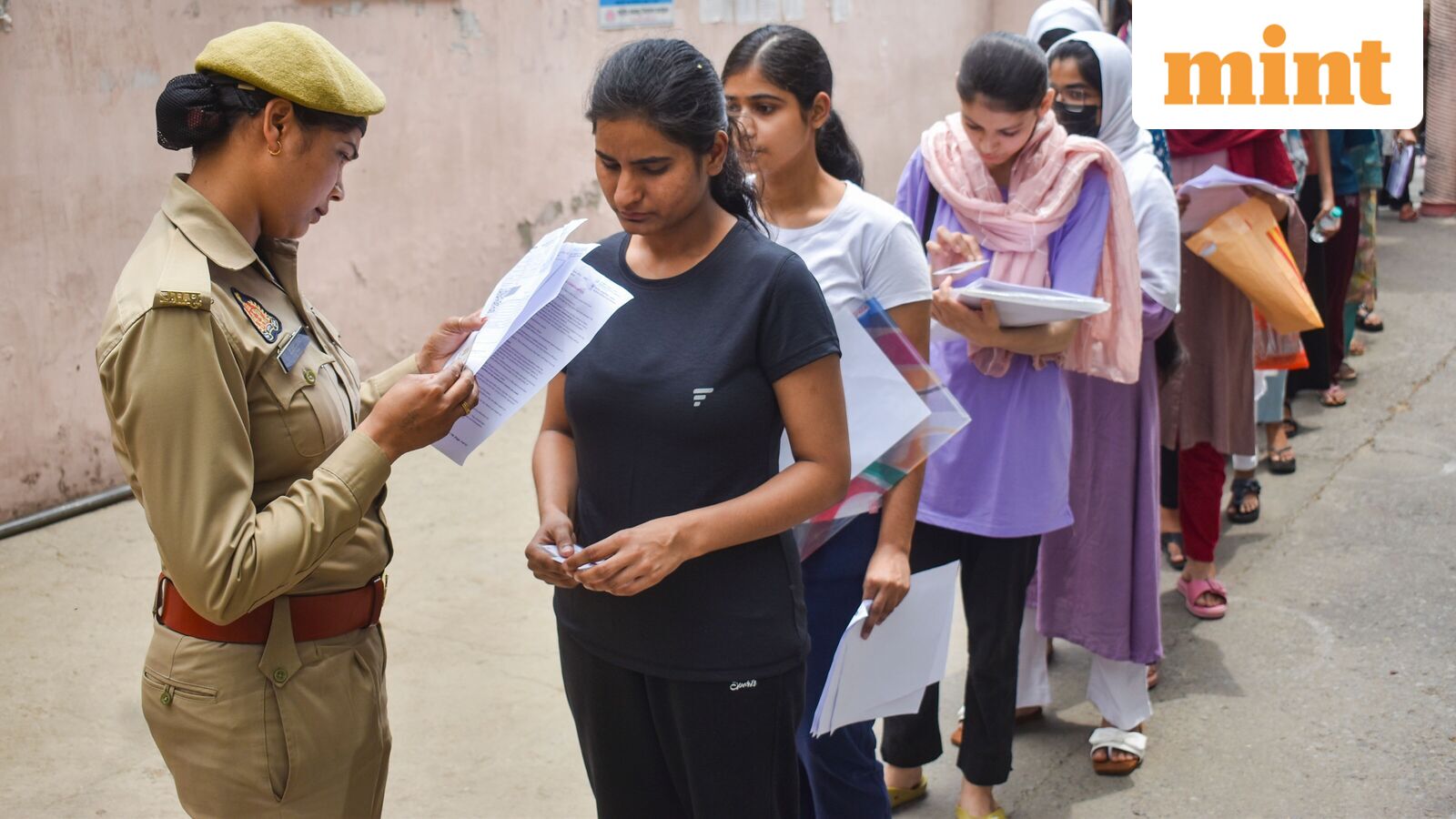
GATE 2026 admit card release date: IIT Guwahati will be conducting the Graduate Aptitude Test in Engineering (GATE). Scheduled for next month between 7 and 14 February, GATE exam scores are used for MTech, MS, and PhD admissions. Initially, the admit card was supposed to release on 2 January but its release date was postponed due to unexplained reasons. As per media reports, it is expected that the hall ticket will be issued on 7 January at the official website at gate2026.iitg.ac.in.
“The release date of the GATE 2026 admit card has been postponed. The revised release date will be announced soon,” the website states. The examination schedule for 32 subjects has been released. The GATE 2026 exam will be held across India in 200 cities in two shifts. Once the admit card link is activated, candidates will be able to download their GATE 2026 exam hall ticket using their enrolment ID and password.
The official website notes, “GATE 2026 is being conducted by IISc and all IITs, on behalf of the National Coordination Board (NCB), Department of Higher Education, Ministry of Education (MoE), Government of India
The national-level examination will take place on 7 February for 16 subjects, for 6 subjects on 8 February, for 7 subjects on 14 February and for 3 subjects on 15 February. It is important to note that GATE scorecard will remain valid for three years.
GATE 2026 exam time
The test timings are given below:
Forenoon – 9:30 am to 12:30 pm
Afternoon – 2:30 pm to 5:30 pm
How to download GATE admit card?
Candidates must follow the steps provided below to download GATE admit card 2026:
Step 1: Visit official website at gate2026.iitg.ac.in and click on application portal to login.
Step 2: Enter enrolment ID, password and security code.
Step 3: The admit card will be displayed on screen
Step 4: Check details, save and download hall ticket. Take a printout and keep it for exam day.
Candidates will be able to download their scorecard on the following dates —
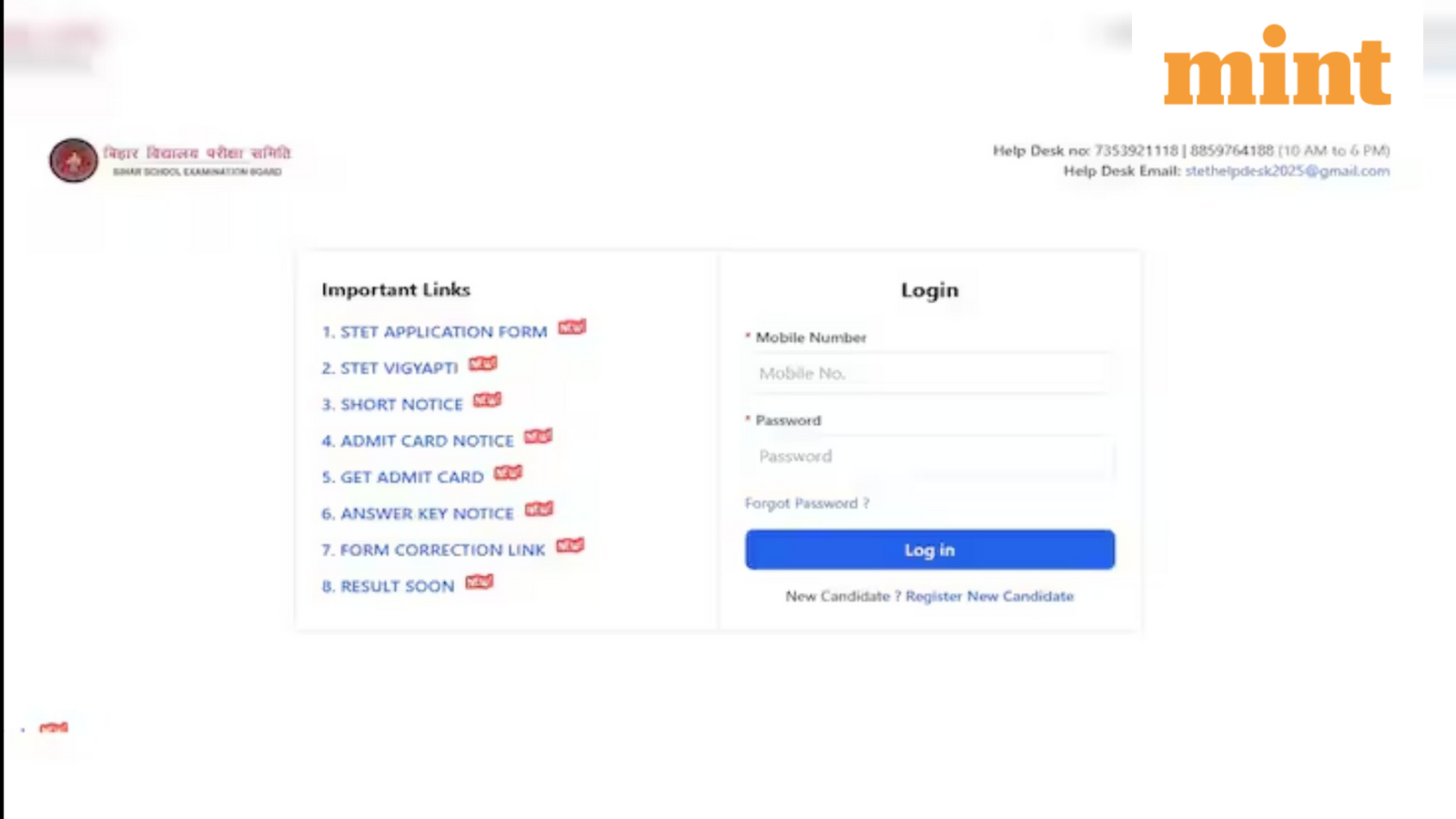
Bihar School Examination Board (BSEB) chairman Anand Kishor officially declared the Secondary Teacher Eligibility Test (STET) 2025 results on Monday.
It said that of the 4,42,214 candidates who appeared for the CBT-based examination held between October 14 and November 16, 2025, a total of 2,56,301 candidates cleared the test. This included 1,04,167 women and 1,52,134 men, with the overall pass percentage standing at 57.96%.
Bihar BSEB STET results 2025: How to download scorecard?
Visit the official websites: bsebstet.com or secondary.biharboardonline.com.
2. Click on the link “Bihar STET Result 2025 / Scorecard” (or a similar option) on the homepage.
3. You will be redirected to the login page.
4. Enter your Registration Number, Date of Birth, and other required details.
5. Submit the details to view your result/scorecard on the screen.
6. Download and print the scorecard, and keep it safely for future recruitment processes.
Bihar BSEB STET results: Which details should you check on scorecard?
The STET 2025 scorecard will display important details such as the candidate’s name, roll number, application number, the paper (Paper I or II), subject, category, marks obtained, and qualifying status.
Candidates who appeared for the Bihar BSEB STET 2025 can calculate their marks once the provisional answer key is released by following the prescribed steps. Each correct response carries one mark, and there is no negative marking for incorrect or unattempted questions. The total score is calculated by multiplying the number of correct answers by one.
The Bihar STET Result 2026 is expected to be announced shortly on the official website. If candidates notice any discrepancy or error in their scorecard, they are advised to contact the BSEB authorities immediately for rectification. Assistance can also be sought through the official helpdesk for resolving such issues.
Meanwhile, candidates who successfully clear the exam will be issued the Bihar STET Eligibility Certificate, which is valid for life. Qualified candidates can reportedly apply for Paper 1 to seek appointments as secondary-level teachers and for Paper 2 for senior secondary-level teaching posts across the state. Once qualified, candidates will not be required to retake the examination and will remain eligible to apply for future teacher recruitment exams.
The Bihar School Examination Board (BSEB) has announced that it will soon release the Secondary Teacher Eligibility Test (STET) 2025 scorecard. BSEB Chairman Anand Kishore had earlier stated that the result will be published on January 5, 2026.
How can candidates check and download the result?
Candidates can check and download their result and scorecard on the official websites: bsebstet.com or bihar-stet.com. The steps to download the result are as follows:
Visit the official website bihar-stet.com.
Log in using your registration number, date of birth, and captcha code.
The Bihar STET Result and scorecard will appear on the screen.
Download and print the scorecard for future reference.
Candidates need to score the following minimum marks as per their category:
General Category – 50 per cent
Backward Classes (BC) – 45.5 per cent
Economically Weaker Section (EWS) – 42.5 per cent
Scheduled Caste (SC)/Scheduled Tribe (ST), Persons with Disability and Women – 40 per cent
What was the exam format?
The STET 2025 exam consisted of multiple-choice questions, with no negative marking. Candidates who pass the exam will receive a passing certificate valid for a lifetime.
Which classes does the STET cover?
Paper 1 is for recruitment of teachers in Classes 9 and 10.
Paper 2 is for recruitment of teachers in Classes 11 and 12.
Educational qualification
Secondary Level Posts: Candidates must have a B.Ed. along with a graduate or postgraduate degree in the relevant subject, securing at least 50 per cent marks. Candidates holding BA-BEd or BSc-BEd degrees are also eligible.
Senior Secondary (Higher Secondary) Posts: Candidates must possess a postgraduate degree in the relevant subject with a minimum of 50 per cent marks, along with a B.Ed.
The Delhi government on Saturday released a detailed admission schedule for entry-level classes for the 2026-27 academic session. The Directorate of Education (DoE), in a notification dated 22 November outlined the specific dates for schools and parents seeking pre-school or nursery admission for their wards.
From uploading of point criteria on school’s website to release of lists the notification provides a full timeline of the admission process. The circular also mentions crucial instructions to schools, prescribed the age limits for attendance, and also gave a list of the documents required as proof of address.
Admission process in Delhi schools is set to begin next month. Those planning to apply for the same must take note of the admission schedule mentioned below.
The admission process will commence on 4 December and conclude on 19 March, 2026.
Registration fee
Parents will have to pay a registration fee of ₹25 to apply in the schools of their choice. “Each school shall display the aforesaid admission schedule on its notice board and website… Only ₹25 (non-refundable) can be charged from the parents as admission registration fee,” the notification reads.
Age limit for entry-level classes admissions
As per the latest notice, age limit for upcoming academic session admissions is given below:
Nursery (Balvatika 1/ Pre School 1): 3+ years upto 4 years
KG: 4+ years upto 5 years
Class 1: 5+ years upto 6 years
“The age relaxation for admission of upto one month may be granted at the level of head of school in the minimum & upper age limit for these classes. The parents may approach the Head of School/Principal for seeking age relaxation through a manua application. For admissions in Academic Session 2026-27 a child must have attained the prescribed minimum age as on 31st March 2026,” the notification states.
Will schools implement DoE’s updated age criteria?
As per a circular released on October 24, the foundational stage will comprise of three classes before Class 1 — nursery (Balvatika 1/ Pre School 2), Lower KG (Balvatika 2/ Pre School 2), and Upper KG (Balvatika 3/ Pre School 3). According to New Education Policy (NEP) 2020, the prescribed age of the child is 6+ years upto 7 years for Class 1 as of 31st March.
Under the existing structure, there are two classes—nursery and KG—in the foundational stage. This implies that the updated age criteria will not be applicable in the upcoming academic session for Class 1. For Nursery admission only the age guidelines of NEP will be followed. The circular doesn’t specify age limits for Lower KG and Upper KG, instead both are clubbed as one category.
The updated age criteria will be implemented in phases from academic session 2026-27, the notice had said.
Parents must take note of the documents that will serve as valid proofs of address, such as ration card or smart card, issued in the name of parents or domicile certificate of the child or the parents, or bills, such as electricity bill, telephone bill, water bill or a passport in the name of the child or the parents, or Aadhaar card issued in the name of the parents, or voter identity card of any of the parents.
BSEB 10th, 12th Bihar Board exam 2026: The portal to download dummy admit cards for Bihar Board Class 10 and Class 12 annual exams 2026 is open and applicants can check and verify their details until the deadline. The Bihar School Examination Board (BSEB) released the dummy hall ticket three days ago, on 21 November.
The board in a post on X stated, “Important information regarding the dummy admit cards of students appearing for the Annual Secondary Examination, 2026, being uploaded on the Board’s website and the need for online error corrections until 27.11.2025.”
Where to check Bihar Board exam 2026 dummy admit card?
Dummy admit cards are available at the board’s official website until 27 November.
The BSEB Class 10 and 12 Dummy admit cards are available on separate portals and can be downloaded from the below mention dedicated websites:
In case of any spelling errors in the students’ names or their parents’ names, or any errors in the category, gender, subject, date of birth, photo, or signature, in the issued dummy admit cards, the corrections will be made by the head of the respective school. Candidates who registered for the BSEB 10th or 12th Bihar Board exam 2026 must verify the details
BSEB sent messages on the registered mobile numbers of all students appearing for the Annual Secondary Examination 2026 regarding the issuance of dummy admit cards. In case of any difficulty arises in downloading or in making corrections in the mummy admit card, helpline numbers 9430429722, 0612-2232239 must be contacted. Email can also be sent to BSEB’s dedicated portal, bseb@antiersolutions.com.
How to make corrections?
BSEB in its notice dated 21 November directed the principals of the affiliated schools to log in using their user ID and password, download the dummy admit cards and promptly issue it to the students.
Step-by-step guide for schools
Step 1: Schools must login to their accounts using essential credentials.
Step 2: Click on Dummy Admit Card in the Committee menu on the left.
Step 3: The user will be directed to a new page displaying the list of students.
Step 4: The Dummy Admit Card can be downloaded by clicking on the View button and corrections can be made by clicking on the Edit button.
How to download dummy admit card online
Step-by-step guide for schools for registered candidates:
Step 1: Visit the official website at exam.biharboardonline.org.
Step 2: Candidates can download their Dummy Admit Card by clicking on the link “CLICK HERE TO DOWNLOAD DUMMY ADMIT CARD STUDENT LOGIN” available on the home page.
Step 3: Enter registration number and date of birth to login.
How to download dummy admit card using mobile app
Step 1: Visit Google Play Store and search for “BSEB Information App”
Step 2: After downloading it, navigate to www.ssonline.biharboardonline.com link available on the home page.
Step 3: Enter the required details to download the dummy admit card.
The Union Public Service Commission (UPSC) has released an official notification regarding the UPSC EPFO admit card, stating that the hall tickets will be made available five days before the examination.
The UPSC EPFO exam is set to take place on November 30, 2025.
Candidates who have applied for the Enforcement Officer/Accounts Officer (EO/AO) and Assistant Provident Fund Commissioner (APFC) positions under the Employees’ Provident Fund Organisation (EPFO), Ministry of Labour & Employment, should regularly check the official website.
Official websites to download admit cards
The admit cards will be accessible on upsc.gov.in and upsc.nic.in. Applicants will need their registration ID and date of birth to log in and download the admit card.
Steps to download UPSC EPFO Admit Card 2025:
1. Visit the official UPSC website: upsc.gov.in.
2. On the homepage, navigate to the “What’s New” section or the “Admit Cards” tab under the Examination menu.
3. Click on the link for “EPFO EO/AO & APFC Examination Admit Card” once it is activated (five days before the exam).
4. Select “Download”, which will redirect you to upsconline.nic.in.
5. Choose to download the admit card using Registration ID or Roll Number.
6. Enter the required details: Registration ID/Roll Number, Date of Birth, and security captcha.
8. Your admit card will appear—verify all information carefully, including your name, exam centre, exam timing, and instructions.
UPSC is conducting this recruitment to fill a total of 230 positions, including 156 vacancies for Enforcement Officer/Accounts Officer (EO/AO) and 74 vacancies for Assistant Provident Fund Commissioner (APFC), as announced earlier in Special Advertisement No. 52/2025.
The vacancies are distributed across various categories. The vacancies are divided into 156 posts for EO/AO and 74 posts for APFC.
The West Bengal School Service Commission (WBSSC) has announced the WBSSC SLST Result 2025 for Classes IX–X. As per reports, the results of the 2nd State Level Selection Test (SLST), held for the recruitment of Assistant Teachers in government-aided schools across West Bengal, are now available on the official website westbengalssc.com.
WBSSC SLST Result 2025: Login details required
Candidates who appeared for the exam on September 7, 14, can log in using their roll number and name to view their results.
The WBSSC SLST Result 2025 includes key details such as qualification status and subject-wise marks.
How to download WBSSC SLST Result 2025 – a step-by-step guide
Candidates who had appeared for the exam can check the WBSSC SLST Result 2025 through the following steps:
Visit the official website: westbengalssc.com
Next, go to the ‘Results’ section on the homepage.
Click on “Result of Written Examination in c/w 2nd SLST (AT), 2025 for Class IX–X.”
Enter your roll number and date of birth, fill in the captcha, and click Submit.
The WBSSC SLST Result 2025 will appear on the screen.
Verify the details and download the result for future use.
WBSSC SLST Result: What details are mentioned on scorecard?
Along with the WBSSC SLST Result, WBSSC has also released the scorecard. Candidates must ensure that their scorecards contain the following details:
Name,
roll number,
application ID,
category of candidate,
exam name,
post level (Class IX–X),
date of exam,
section-wise/overall marks and qualifying status.
Next steps after WBSSC SLST Result
Shortlisted candidates can now gear up for the next stage of the recruitment process. The upcoming rounds of the WBSSC SLST include an interview followed by document verification.
For verification, candidates are required to carry their WBSSC SLST Result 2025 scorecard PDF along with original educational certificates, identity proof, caste or reservation documents (if applicable), and other important documents.
Ahead of the placements starting on 1 December, IITs have established testing venues with biometric entry and restricted Wi-Fi networks to block AI tools in online tests, multiple placement coordinators at IITs said. Companies are also deploying sophisticated software to monitor and prevent cheating behaviours such as unauthorized internet searches and tab switching.
Organizations looking to prevent AI use primarily deploy authentication tech and firewalls, said Jaspreet Singh, chief revenue officer at Grant Thornton Bharat who specializes in AI and tech. When a candidate connects to a centralized system, the organization will block the usage of certain websites and applications.
“This is being done at IITs through the common WiFi they use to give examinations on campus. Further, proctoring and motion-sensing detects your movements and makes sure you are not switching tabs. Even if students bypass this, there are plagiarism detection software that campuses and recruiters use to ensure that responses submitted by students are original,” Singh said.
For now, recruiters want to build upon students’ foundational knowledge once the employees are onboard, making tech school recruitment distinct from B-schools, where AI is often utilized to test higher-order analytical skills. Some of the Indian Institutes of Management (IIMs) actively increasingly integrate and encourage the use of AI. The rationale for the divergence between IIT and IIM hiring is rooted in the desired output from a tech graduate.
“Recruiters aim to evaluate students based on their raw thinking abilities, rather than their AI capabilities, during the screening phase,” said John Jose, head of the Centre for Career Development at IIT Guwahati and co-convener at the All IITs Placement Committee (AIPC). “They are seeking candidates whose basic concepts are clear, who possess the necessary technical skill set, and who demonstrate sharp logical reasoning.”
However, Singh of Grant Thornton Bharat LLP believes that recruiters should allow the use of AI at campus exams, since it is the most important skill in the market right now and the mechanisms to avoid AI usage aren’t foolproof. “Eventually, students may find their way around it; so, it is better to democratize and allow use of AI for a better assessment of candidates.
A student placement coordinator highlighted that the real pressure test is not about solving an isolated, complex problem, but about speed and performance under time constraints. For example, a typical probability question from a placement test, which a student might be able to solve given ample time, becomes a test of efficiency when dozens of similar questions must be tackled within strict, career-defining time limits. Students, the coordinator admitted, are tempted to use AI not to skip solving problems, but to accelerate the process and finish exams on time.
Alongside, another shift is under way: beyond stellar coding scores and math prowess, the class of 2026 is finding itself increasingly judged on personality, team compatibility, and cultural fit, a move driven by corporate demand for long-term retention and high-performing hires.
The heightened focus on non-technical skills follows last year’s challenging hiring cycle, which saw hundreds of rigorously prepared students fail to secure positions at the end of the placement season at established IITs—including Bombay, Delhi, Guwahati, Kanpur, Kharagpur, Madras, and Roorkee. While a slight uptick in pre-placement offers this year has thinned the candidate pool, the IITs are intensifying efforts to ensure maximum placement success.
Recruiters are moving past the hunt for mere “coding wizards” and “tech geniuses,” shifting their emphasis to team players who demonstrate resilience and commitment. This preference is translating into the widespread use of psychometric and behavioural analyses to identify students with a well-rounded profile.
“Recruiters are broadening their evaluation beyond technical competency to assess if our students are culturally fit for group work,” Jose of IIT Guwahati said. “This involves testing their sensitivity and emotional quotient (EQ) to ensure the employee’s long-term career success within the organization.”
The queries emailed to the IITs mentioned above remained unanswered.
Placement heads confirm that the demand for evaluating these softer competencies has strengthened this year. According to one IIT placement official, approximately 25% more recruiters are insisting on these skills, with major financial institutions like Standard Chartered and HSBC cited as examples of firms employing these assessment methods. Emails sent to both firms remained unanswered.
In response, the IITs are actively investing in bridging the skill gap, engaging management consultants and professional trainers to polish candidates’ interpersonal skills and interview delivery. These professionals also provide crucial guidance to students on assessing whether a prospective company aligns with their career goals, a proactive measure aimed at mitigating costly job hopping and early attrition.
“We have recently hired a new Training and Placement Officer and a Personality Development Trainer to conduct specialized training,” Jose of IIT-Guwahati added. “This is necessary because in the past, our students have generally been exposed only to technical knowledge and not these essential skill-based courses.”
The institutes are also leveraging their extensive alumni networks to host dedicated workshops, talks, and training sessions, helping students prepare for specific roles and organizational cultures within their own companies.
Student placement coordinators also noted the growing interest in extra-curricular activities and sports. One coordinator pointed out that participation in student clubs—ranging from debating and music to robotics and finance—has noticeably increased, driven by the realization that placement evaluations now prioritize holistic development. The current season’s high demand for data analyst and quantitative (quant) finance roles has, in particular, galvanized members of finance clubs to specialize in those domains.
“Employers are investing serious money and time into every campus hire, so if a new recruit becomes disillusioned and quits quickly because they are not a good fit, the organisation loses that investment and the value never really accrues,” commented Hardeep Singh, president at Right Management India, which partners with engineering and management institutes for placement preparation.
Singh said the rigorous process, starting with comprehensive assessments, helps students gain clarity on their true strengths, interests, and fit with potential employers. This ensures they make informed career decisions based on competence and personality rather than succumbing to peer pressure or market trends.
“Once this clarity is achieved, the next phase focuses on thorough placement preparation, including resume crafting, interview coaching, and mock sessions,” Singh of Right Management explained. “Employers increasingly look for candidates who demonstrate a clear purpose and alignment with the role, which enhances their confidence in long-term success and retention.”
In addition to advanced screening, companies are restructuring pay packages to boost retention. Many firms are now implementing a staggered bonus structure, splitting joining bonuses across multiple years. This involves an initial signing bonus, followed by subsequent installments upon the completion of each year, incentivizing new hires to stay longer.
The Central government has introduced a new scholarship scheme for Scheduled Caste (SC) students, Top Class Scholarship for SC Students 2025-26, with the aim of recognising and promoting quality education amongst students belonging to the reserved group.
The Scheme will cover SC students pursuing studies beyond Class 12 and will operate in all institutions notified by the Ministry of Social Justice and Empowerment for FY 2024-25 to 2025-26.
However, the scholarship, once awarded, will continue until the completion of the course, provided the student’s performance is deemed satisfactory.
SC Students Scholarship 2025-26: ‘Top Class’ Institutions
All the IIMs / IITs/ IIITs / AIIMSs/ NITs/NIFTs/ NIDs/ IHMs/NLUs and other Central Government Institutions will be eligible.
If an institution is not in any of the above categories, it has to be included in the current list of:
i) National Assessment and Accreditation Council (NAAC) A++ and A+ Accredited Institutions
ii) Top 100 National Institutional Ranking Framework (NIRF) Institutions
iii) Institutions of National Importance as per lists issued by the Ministry of Human Resource Development (MHRD) from time to time.
CBSE CTET 2026 Registration: The Central Board of Secondary Education (CBSE) has started the Common Teacher Eligibility Test (CTET) 2026 registration from today, November 27. The CTET 2026 examination will be held in February 2026, with registrations closing on December 18, 2025.
What is CTET exam?
The Central Teacher Eligibility Test is one of the mandatory eligibilities for appointment as a teacher for class 1 to VIII. The national-level examination is conducted to test the eligibility of candidates as Primary (Classes 1 to 5) or Elementary (Classes 6 to 8) teachers. It is mandatory to clear the examination to attain the eligibility to teach in central government schools like KVS, NVS, etc.
CTET 2026 Registration: Direct link of website
Candidates can register for the CBSE CTET 2026 exam with the direct link to the official website at https://ctet.nic.in.
CTET 2026 registration fee
The examination fee for the registration of CBSE CTET examination is ₹1,000 for only Paper I or II and ₹1,200 for both Paper I and II for General/ OBC(NCL) category candidates. The CTET exam registration fee is ₹500 for only one paper and ₹600 for both papers for candidates of SC/ ST/ Differently Abled Person category.
CTET 2026 Registration: Steps to apply
Step 1. Go to the official CBSE CTET website at https://ctet.nic.in.
Step 2. On the homepage, click on the link that says “Apply for CTET 2025.”
Step 3.If you are a first-time user, click the “New Registration” option. Fill in details like your full name, parents’ names, and date of birth in capital letters.
Step 4. Choose the preferred exam city and the language in which you want to take the test (English or Hindi).
Step 5. Enter your Aadhaar number, gender, category, employment status, and detailed educational qualifications, including marks you obtained.
Step 6. Now enter your active communication address, mobile number, and a valid email ID for receiving notifications.
Step 7. Upload a recent passport-sized photograph and your signature in the either JPG/JPEG format against a white background as prescribed.
Step 8. After submitting the details, go to the payment gateway and complete the transaction using your preferred mode.
Step 9. Review all details carefully and click the “SUBMIT” button.
Step 10. Make sure to download PDF and print the final confirmation for your future use.