Why Japanese toilets are used facing forward and most visitors get it wrong |


Why Japanese toilets are used facing forward and most visitors get it wrong

In public places across Japan, older floor-level toilets still appear with some regularity. They sit low to the ground, set into tiled floors, and look unfamiliar to many visitors. What often causes more confusion than the fixture itself is how it is meant to be used. People are expected to squat facing one specific direction, toward a curved hood built into the porcelain. This is not a social preference or a cultural quirk passed down without thought. It is a practical response to how these toilets are designed and maintained. The orientation affects cleanliness, comfort, and shared use. In stations, schools, and roadside facilities, this small detail reflects a broader approach to public infrastructure that prioritises function and quiet order over explanation.

Traditional public toilets in Japan rely on posture and layout

The traditional Japanese squat toilet, known as a washiki, is shaped to guide the body without instruction. One end of the fixture rises slightly and curves upward. This is the front. Facing it places the body over the deepest part of the bowl, where waste is meant to fall and flush cleanly.The slope inside the toilet relies on gravity working in a particular direction. When used correctly, water flows efficiently, and residue is less likely to remain. Turning around works against that design and often leads to splashback or soiling. Over time, this affects maintenance and hygiene, especially in busy public spaces.

Traditional public toilets in Japan rely on posture and layout

Traditional public toilets in Japan rely on posture and layout (Image Source – Wikipedia)

Cleanliness matters in shared spaces

Many washiki toilets remain in locations with heavy footfall. Train stations, schools, parks, and rural stops still rely on them because they are durable and easy to wash down. They have fewer moving parts and cope well with constant use.Facing forward reduces the chance of clothing touching contaminated surfaces. It also helps keep the surrounding areas clean for the next person. In a society where shared responsibility for public spaces is taken seriously, this matters. The posture supports a standard of use that does not need to be discussed.

Posture supports the body as well

Squatting itself is known to support bowel movement by aligning the body more naturally. The forward-facing position enhances this effect by matching posture to the bowl’s shape. Users are balanced and stable, with less strain. This is not framed as health advice in everyday life. It is simply how the fixture works best. Over time, familiarity removes the need for conscious thought. People follow the design because it feels correct.

Privacy is shaped by orientation

Older public toilet stalls in Japan often lack full-height doors. Facing the raised hood places the user’s back toward the entrance. This creates a small but meaningful sense of privacy. It also limits what might be visible from outside the stall. This consideration fits within a wider concern for modesty in public settings. The design supports discretion without relying on additional barriers.

Sound and etiquette sit alongside function

Japanese toilets often include features aimed at reducing embarrassment. In many women’s restrooms, sound masking devices play a flushing noise to cover bodily sounds. These additions reflect sensitivity to shared discomfort rather than necessity. They sit alongside older design choices like washiki toilets. Both assume that behaviour will adapt quietly to the space provided. Instructions are minimal because the expectation is already set.

Modern toilets have not erased older habits

High-tech toilets are now common in homes and newer buildings. Heated seats and bidet functions dominate popular images of Japanese bathrooms. Still, the older squat toilets remain part of the landscape. Their continued use reinforces a posture that is practical rather than symbolic. Facing forward persists not because of tradition alone, but because it still works. In many places, that is reason enough.



Source link

Relationship tip of the day: Ruskin Bond’s witty reality check about marriages- “Red roses for young lovers, French beans for…” |


Relationship tip of the day: Ruskin Bond's witty reality check about marriages- “Red roses for young lovers, French beans for..."

Remember that butterflies-in-your-stomach phase of love? The candlelit dinners, stolen glances, and endless poetry about soulmates? But what happens when the fairy tales get a reality check – bills, Monday blues, or taking care of kids and parents? India’s beloved storyteller from the hills, Ruskin Bond, nails it with his witty, heartfelt reality check: “Red roses for young lovers. French beans for longstanding relationships” – a quote from his ‘Book of Nature’. At 91, this master of simple wisdom reminds us that marriage or long-lasting relationships aren’t always going to be in the honeymoon phase – it’s a garden you tend, one humble bean at a time. And honestly? It’s the most romantic truth that you’ll hear today, about how love transforms.

The honeymoon high: Roses and their thorny allure

Remember the early days of your relationship when he brings home a single red rose “just because,” she’s lighting candles after a long day, and every touch feels electric. Ruskin Bond captures that magic perfectly in his quote – red roses symbolise passion’s fiery bloom, the intoxicating “us against the world” vibe. It’s pure, heady emotion, like the first rain kissing parched earth in his Himalayan tales. We chase it in movies, songs, and Instagram reels, hearts swelling with dreams of forever young love.

Celebrated author Ruskin Bond turns 98. Here is how his birthday was celebrated

But here’s the emotional reality: Roses wilt with time. And similarly, relationships too slowly shift– from the initial fireworks to quiet comforts. But Ruskin Bond doesn’t mock it; he acknowledges and honours it. Those early roses are vital, watering the roots of commitment. Without them, you’d never plant the deeper harvest. Relatable? Absolutely. If you’re in that rosy phase of your marriage or relationship, savour it – it’s the beginning of something even richer in life.

The long haul: French beans and everyday magic

Fast-forward a decade: Couples get busy with kids and their school runs, share grocery lists, and yes, French beans that are often cooked for meals. No fanfare, no sonnets – just a long-married couple and their steaming plate of sustenance. In this quote, Bond’s genius lies in flipping the “mundane” into profound. French beans aren’t glamorous; they’re nourishing, reliable, growing steadily through storms. They represent marriage’s quiet heroism – the inside jokes, the knowing glance during family chaos, the hand on your back saying, “We’ve got this, together.So, the relationship tip of the day? Embrace the shift. If you’re in rose season of your relationship/marriage, great – nurture it. But if life’s serving beans, lean in with gratitude. Ruskin Bond teaches us: True romance isn’t in the bloom; it’s in the harvest. It’s emotional resilience, choosing “us” when passion quiets to peace.In a world screaming for perfection, Bond’s words are a warm hug: Love evolves, and that’s beautiful. What’s your “French beans” moment with your partner? Tell us in the comment section below.


Source link

UAE rail revolution: Nation’s first passenger train network launching in 2026, know how it will impact travellers |


UAE rail revolution: Nation’s first passenger train network launching in 2026, know how it will impact travellers

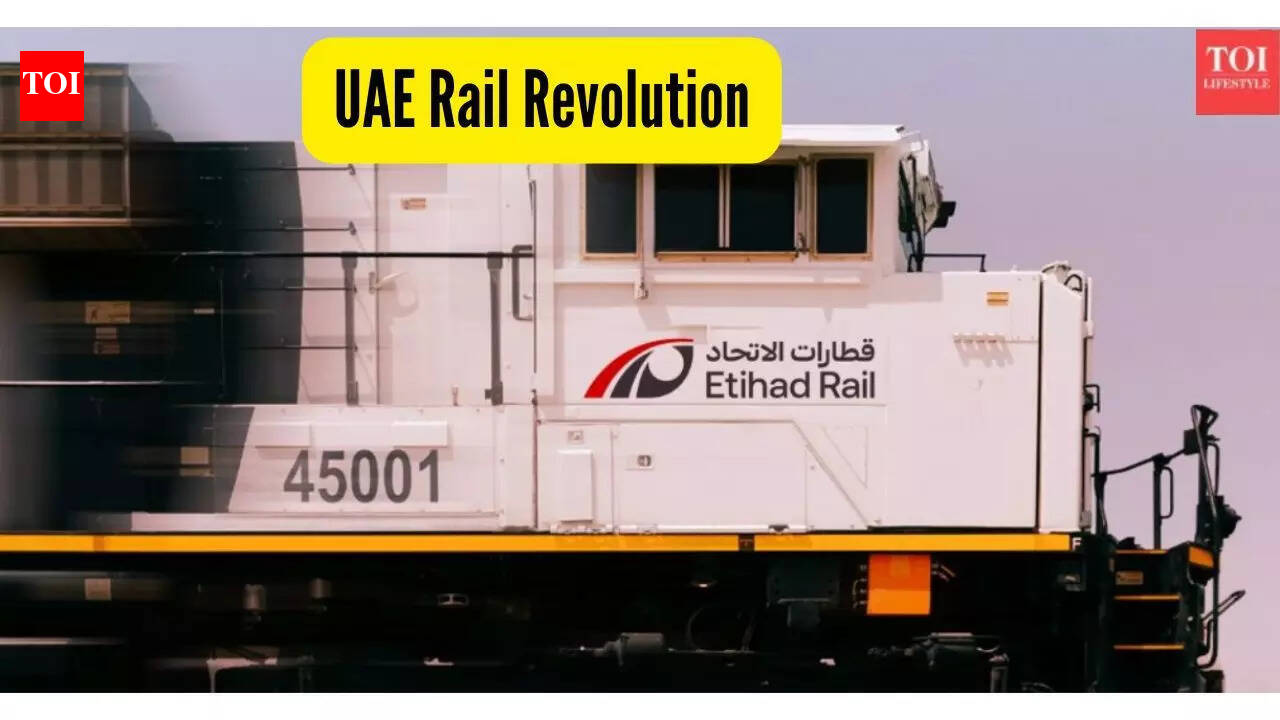
The United Arab Emirates is all set for a rail revolution in 2026 which is going to transform the country’s travel landscape. The launch of UAE’s first fully integrated national passenger rail service remains one of the much-awaited events. This milestone will reshape tourism and connectivity across the seven emirates, which are Abu Dhabi, Dubai, Sharjah, Ajman, Umm Al Quwain, Ras Al Khaimah, and Fujairah. The historic project is spearheaded by Etihad Rail.A new era of train travelEtihad Rail, the developer and operator of the UAE’s national rail network, has officially announced plans to inaugurate passenger rail services in phases during 2026. This initiative builds on years of planning and construction. It represents the UAE’s future vision. The network is designed to cover approximately 900 km of track, stretching from Al Sila close to the Saudi Arabian border in the west to the eastern emirate of Fujairah. Stations and RoutesWith passenger services set to launch next year, Etihad Rail has revealed the full list of 11 stations:Abu DhabiDubaiSharjahFujairahAl Sila’Al DhannahAl MirfaMadinat ZayedMezaira’aAl FayaAl DhaidIn its first phase, passenger rail services will connect Mohammed Bin Zayed City in Abu Dhabi, Jumeirah Golf Estates in Dubai, University City in Sharjah, and the Al Hilal area in Fujairah. Etihad Rail’s stations, unlike traditional rails, are designed for connectivity with regional transport networks. It will change the way people travel inside the city. Speed and AmenitiesAs per official update, each train can carry up to 400 passengers. Some of the prominent features of the trains are that each feature has ergonomic seating, modern interiors, Wi-Fi, and power outlets. The service will operate on a schedule and will allow travellers reliable alternatives to road journeys. The network will also reduce travel time between Abu Dhabi and Dubai which is estimated to be around 57 minutes from two hours on road journey (minus peak traffic). A trip from Abu Dhabi to Fujairah is expected to take about 105 minutes.Impact on tourism The upcoming passenger rail service is expected to connect several emirates and tourism hotspots. With this, Etihad Rail is set to boost domestic tourism and ease peak hour traffic on roads. Sustainable FutureThis is a perfect example of how global cities are looking for alternatives to car-dependent travel. The UAE’s new passenger rail network represents a bold investment in sustainable infrastructure. With this, they aim to reduce carbon emissions and promote energy efficiency. The countdown has begun for the dawn of a new era in UAE travel.On this note, let’s have a look at 5 must-visit attractions in the UAE.Burj Khalifa, Dubai: The heart of UAE, Burj Khalifa in Dubai is the world’s tallest building at 828 metres. There are other records attached to the tower, including the highest occupied floor in a tower, longest elevator travel distance, and the world’s highest outdoor observation deck, among others. Sheikh Zayed Grand Mosque, Abu Dhabi: Your trip to Dubai would be considered incomplete without a visit to Sheikh Zayed Grand Mosque, which is counted among the most beautiful mosques in the world. It is also known as a masterpiece of Islamic architecture, housing the world’s largest hand-knotted carpet.Louvre Abu Dhabi: Then there is Louvre Abu Dhabi on Saadiyat Island. It is the Arab world’s first universal museum featuring a striking dome which creates a “rain of light” effect. The whole building is a work of art. Dubai Desert Safari (Arabian Desert): When in Dubai, you can’t miss out on Dubai Desert Safari. It is the best way to witness the UAE’s natural and raw side beyond skyscrapers. People can enjoy dune bashing, camel rides, and stay in traditional Bedouin-style camps.Hajar Mountains & Jebel Jais, Ras Al Khaimah: This place is a heaven for nature and adventure lovers. Jebel Jais is the highest peak of the UAE and a landmark attraction. It is set in the Hajar Mountains of Ras Al Khaimah.


Source link

7 modern apartment features homebuyers look for


Today’s apartment buyers may own cars and require parking facilities, including EV charging points. Connectivity is another aspect that is in high demand, including easy access to public transport, robust internet connectivity, and proximity to essential services. Apartments that are future-ready, with facilities such as EV charging points and high-speed connectivity, are highly sought after in the current market.

Modern homebuyers look for apartments that are more than just a living space; they look for smart, functional, comfortable, and future-ready homes. Facilities such as smart technology, functional design, wellness facilities, quality interiors, functional utilities and future-ready facilities help apartments become highly sought after in today’s competitive real estate market.

Image Credits: Canva


Source link

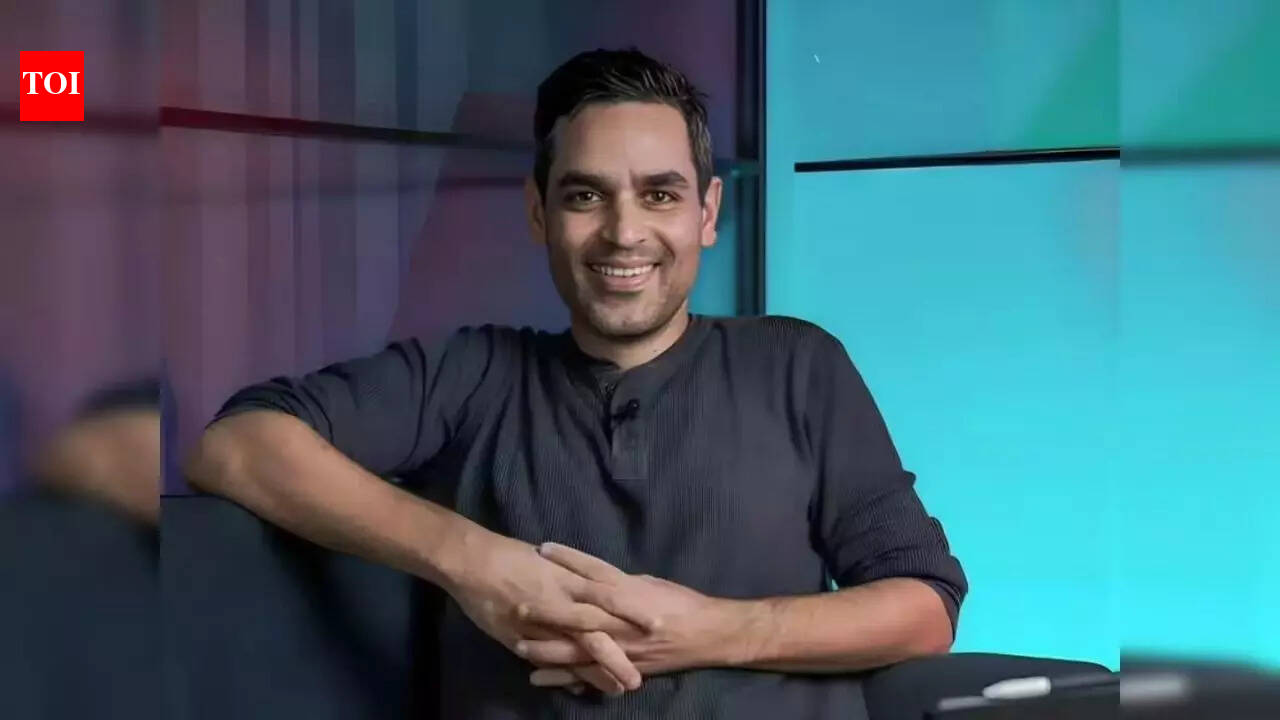
Ankur Warikoo shares 5 smart tips for starting a new job and standing out early: “Start with curiosity, not…” |


Ankur Warikoo shares 5 smart tips for starting a new job and standing out early: “Start with curiosity, not…”

Starting a new job is always a mix of excitement and panic. It seems like everyone expects instant results. You want to show your worth. But rushing in can backfire. The first 90 days often decide how smooth or messy the next few years will be. Experts say the real challenge isn’t speed. It’s understanding the culture, the people, and the unspoken rules. Many of us make the mistake of confusing activity with impact. Doing a lot doesn’t mean doing the right things. It might even hurt your reputation.If you get this phase right, it can set you up for years of success. Get it wrong, and it feels like walking uphill every day. It seems obvious, but many overlook it. And honestly, it’s not just about doing your job well. It’s about how you’re seen. How people listen to you and how do they take you seriously.

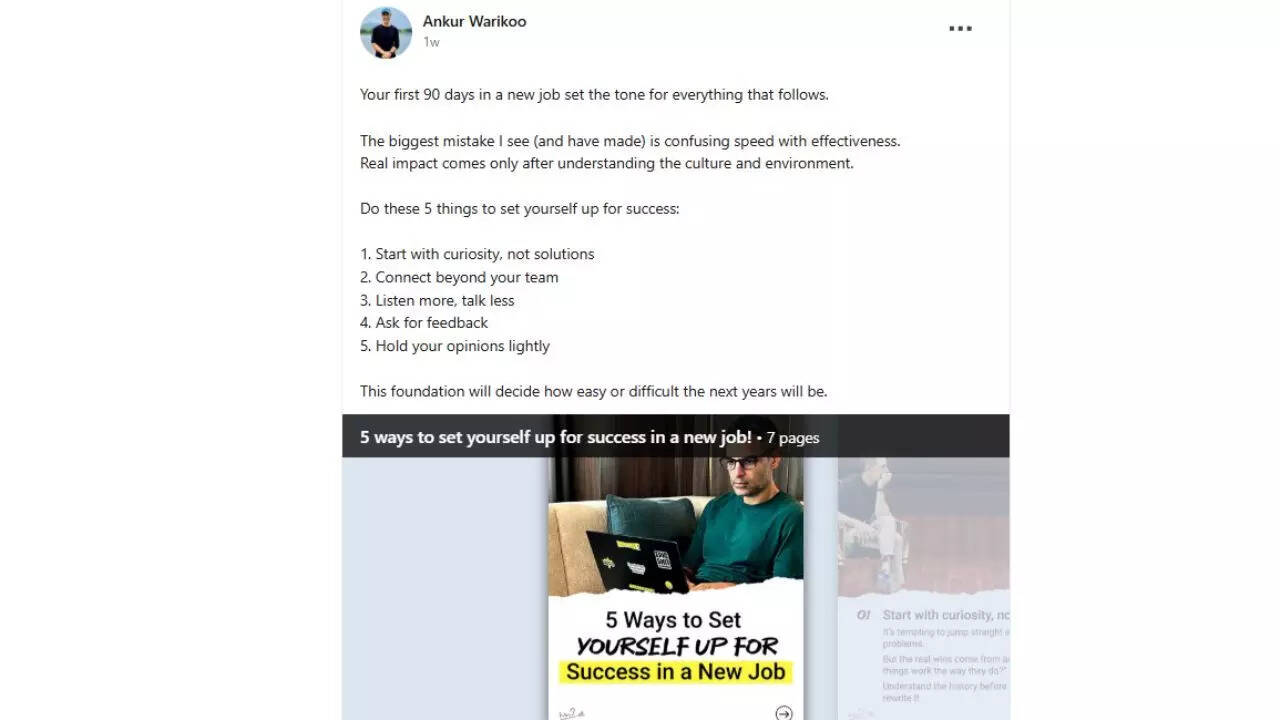
Ankur Warikoo reveals 5 things to set yourself up for success

It might feel like a short period, but it shapes the future. Observing, connecting, listening carefully, asking, reflecting, holding ideas lightly; it all quietly adds up over time. Ankur Warikoo shares that these small, consistent steps seem minor, almost invisible, but they often decide whether your years ahead are smooth, meaningful, or frustrating.So, pause. Look around. Ask questions. Be curious. Stand your ground gently. Stay patient, stay aware, and remember: speed isn’t impact. Understanding is.Your career might just thank you for it.

Ankur Warikoo reveals 5 things to set yourself up for success

Source: LinkedIn

Don’t rush and start with curiosity

It might be tempting to offer solutions immediately. Don’t. Not yet. The smartest move is to observe. Ask questions. Listen. Watch how teams work. Who talks? Who doesn’t? What matters, really?Curiosity shows you care. People notice. It’s subtle, but it builds trust. Jumping in with answers too soon can make you seem overconfident. Or worse, out of touch.

Connect beyond your team

It seems small, but those coffee chats, brief hallway conversations, even awkward hellos matter. You never know which connection will help later.Some colleagues might appear distant at first. Don’t take it personally. Experts say building relationships across departments often gives insights you can’t get from emails or meetings.

Listen more. Talk less.

Simple advice. Hard to follow. Many of us fill silence with words. But silence is powerful. It lets you understand dynamics, catch nuances, and notice what really matters.You might learn more by listening than by giving advice. It appears obvious, but it’s easy to forget.

Ask for feedback and mean it

It feels uncomfortable, doesn’t it? Asking people how you’re doing. But feedback early on can save months of mistakes.Try small steps. Quick check-ins. Short questions. “Did that make sense?” “Was this helpful?” People often respect it when you show you want to learn.

Hold your opinions lightly

Having ideas is good. Pushing them too hard? Not so much. People can sense when approval matters more than your opinion. And when that happens, respect fades.Not everyone will agree. That’s fine. Your thoughts still deserve space. Sometimes stepping back shows confidence more than pushing forward.

Earning respect without losing yourself

Once you’ve settled in, the next challenge is influence. How to earn respect without chasing nods or validation. It seems tricky. But reportedly, people notice authenticity more than effort to please. Ankur Warikoo explains that when you’re too focused on approval, influence drops. People might nod politely, but they stop taking you seriously. The trick is subtle. Speak clearly. Stand by your ideas. Listen when it matters. And don’t fear disagreement.Even small gestures count. Eye contact. Following up on promises. Owning mistakes. It all adds up. Respect isn’t about being liked it’s about being reliable and confident, without pretending to be someone else.


Source link

The Eri ‘Ahimsa’ silk stole worn by Ursula von der Leyen carries a powerful message


The Eri 'Ahimsa' silk stole worn by Ursula von der Leyen carries a powerful message
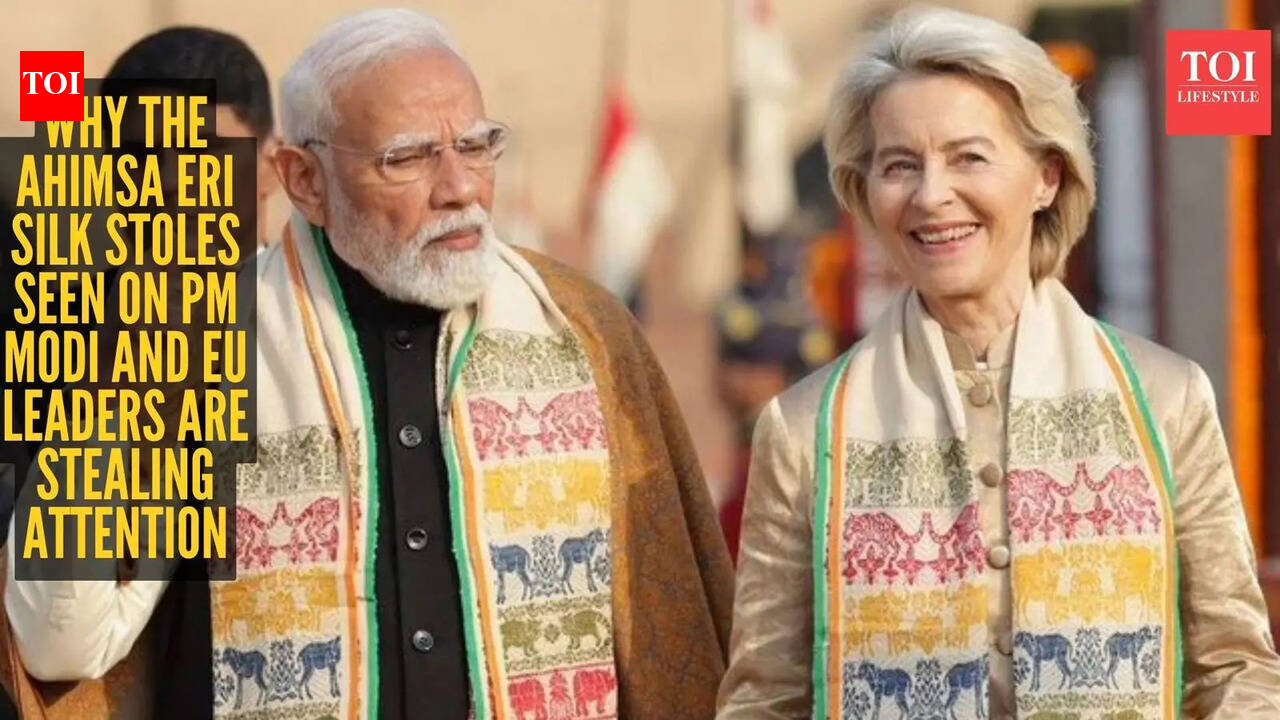
Prime Minister Modi and EU leaders sported matching Northeastern Eri silk stoles, a thoughtful Republic Day gift highlighting India’s rich craft traditions. This ethical ‘Ahimsa silk,’ known for its warmth and durability, signifies a commitment to sustainability and cultural heritage on the global stage, subtly weaving India’s story into international diplomacy.

When Prime Minister Narendra Modi stood beside European Commission President Ursula von der Leyen to announce the India–EU Free Trade Agreement, it wasn’t just the deal that grabbed attention. What really made people pause was what they were wearing. Draped over both leaders’ shoulders was a simple, elegant stole from India’s Northeast – understated, yes, but packed with meaning.After nearly 18 years of back-and-forth, the trade agreement is being called one of India’s most important global partnerships. Ursula von der Leyen summed it up in an X post, calling it the “mother of all deals” and pointing to a new free trade zone connecting almost two billion people. But while policy headlines did their rounds, social media zoomed in on something else entirely: those matching Eri silk stoles.

A Republic Day gift with deep roots

The stoles weren’t a random styling choice. They were part of India’s Republic Day 2026 invitation extended to Ursula von der Leyen and European Council President António Costa. The idea was simple but thoughtful – spotlight the living craft traditions of the Northeast.The design honoured the Ashtalakshmi states – Arunachal Pradesh, Assam, Manipur, Meghalaya, Mizoram, Nagaland, Tripura and Sikkim, and the artisans who keep these traditions alive. During the 77th Republic Day celebrations, several ministers and visiting dignitaries were seen wearing the same stole, quietly reinforcing that India’s global image today isn’t just about power and policy, but also about culture and craft.

So, what exactly is Eri silk?

Eri silk isn’t your typical glossy, high-shine silk. It’s softer, warmer and far more grounded. It carries a Geographical Indication (GI) tag and is often called an “Ahimsa silk” – because no silkworm is killed in the process. The moth is allowed to emerge before the cocoon is spun, making it one of the most ethical silks in the world.This fabric has been traditionally nurtured by indigenous communities, especially the Khasi people of Meghalaya. The spinning and weaving are done by hand, often within homes, passed down through generations. Every Eri stole comes with stories – of patience, skill and a slower way of making things.

Why it’s called the ‘wool of silks’

What really sets Eri silk apart is how wearable it is. It keeps you warm without feeling heavy, and breathes beautifully even in milder weather. Soft, sturdy and comfortable, it works across seasons – which is why it’s often called the “wool of silks”.Eri stoles and shawls are known to last for years, even decades. Beyond stoles and gamosas, the fabric finds its way into sarees, scarves, dresses, sweaters and blankets – pieces meant to be used, loved and lived in, not locked away.It’s also naturally hypoallergenic, making it a favourite for people with sensitive skin – a detail that matters more than ever as people become choosier about what they wear.

More than just a fashion choice

At a time when fast fashion dominates and trends change overnight, choosing Eri silk for a moment of global diplomacy sends a quiet but clear message. It speaks of sustainability, ethical choices and respect for regional craft – and puts the Northeast front and centre on the world stage.The stoles worn by PM Modi and EU leaders weren’t about flashy luxury. They stood for something deeper – a fabric that values life, honours tradition, and carries India’s cultural story into global conversations, without needing to say a word.


Source link

What is ‘drag path’ on TikTok? The viral trend that is breaking hearts


TikTok trends usually promise chaos, humour or a new slang word that makes millennials panic. This one is different. Over the past week, a deeply emotional trend centred around the phrase “drag path” has taken over feeds, leaving viewers confused, teary-eyed and unexpectedly reflective.

Instagram/hercampuse | A drag path is literally a visible trail or mark that has been left on the ground by dragging an object.

Image credit : Instagram/hercampuse | A drag path is literally a visible trail or mark that has been left on the ground by dragging an object.

A new TikTok trend that hits a little too hard

At first glance, the videos look simple. A short clip. Muted music. Text on screen. But then you read it, and it lands right in your chest. Creators are sharing moments connected to someone they lost, often a final interaction they did not realise was the last at the time.

In its literal sense, a drag path is a physical trail left behind when something is pulled across the ground. On TikTok, though, the phrase has evolved into something far more emotional.

Within this trend, a “drag path” refers to the emotional marks left behind by loss. It is the memory, object or moment that still drags through your life long after someone has gone. It is not loud grief. It is the quiet kind that sneaks up on you in random moments.

People are using the phrase to describe memories that only gained weight after tragedy struck. A final birthday. A hospital visit. A casual question that now feels unbearable in hindsight.

The trend pulls its name from the song Drag Path by Twenty One Pilots. The track explores the idea of leaving behind deliberate traces, evidence that something once existed and mattered. While the song itself has been interpreted in many ways, TikTok users have reshaped the phrase into a shorthand for emotional residue.


Source link

Yasuko Tamaki: Meet the 95-year-old Japanese woman who has worked for over 65 years at the same job: “I was born to be useful to others” |


Meet the 95-year-old Japanese woman who has worked for over 65 years at the same job: "I was born to be useful to others"
Meet the 95-year-old Japanese woman who has worked for over 65 years at the same job

Imagine clocking into the same office for 65 years straight—not switching jobs, not chasing promotions, just showing up with quiet dedication while the world around you spins through recessions, tech revolutions, and generations. That’s Yasuko Tamaki, a 95-year-old from Osaka, Japan, whose story feels like a warm hug for anyone who’s ever wondered, “What’s my purpose in life after all these years of work?” In November 2020, the Guinness World Records crowned her the world’s oldest office manager, but reports rom 2024-2025 suggest she’s still going strong at Sunco Industries. At 95? That’s not a career; that’s a love letter to life and work itself!

Meet Yasuko Tamaki, who is still working in her 90s

Born May 15, 1930, Yasuko joined Sunco Industries, a tiny company back then, in 1956 at age 26—a fresh-faced dreamer amid just 20 coworkers. Roughly seven decades later, Sunco now has over 430 employees– including Yasuko. As per reports, over the years, she has evolved from basic admin to general affairs powerhouse: crunching numbers, streamlining communications, even mastering computers in her late 60s when most people of her age were learning solitaire. She was promoted to section chief at 40, and she never stopped growing. Yasuko even aced the Japan Kanji Aptitude Test at 86 to keep her mind razor-sharp. Who says age is a limit?Her daily ritual includes waking up at 5:30 a.m., doing 30 minutes of yoga, reciting Buddhist sutras for wisdom, and then commuting to work by foot, bus, or metro. In her free time she enjoys reading books, mahjong marathons, card games, and dishing gentle advice to her coworkers.


Source link

From Manali to Spiti, 5 places in India that are seeing minus temperatures right now


It seems winter has once again tightened its grip across the Himalayas, with several popular destinations in North India recording sub-zero temperatures. Chill nights, frost mornings and snow-covered roads – these are some of the issues that a few regions are grappling with as cold waves intensify. There are places from hill towns to isolated high-altitude cold deserts that are under blankets of snow and biting winds. Water pipes freeze, travel is hindered, and residents try to grapple with the way of life that challenges both the infrastructure and one’s endurance. The brutal cold, while inconvenient for travel and daily life, also turns the region breathtakingly beautiful. Here are five locations where temperatures have fallen far below freezing, where most of the roads are closed, and are likely facing the last touches of winter, but are at their best form in snowy white.


Source link