How Indians can apply for the Spain’s Digital Nomad Visa: Eligibility, income and long-term stay |


How Indians can apply for the Spain’s Digital Nomad Visa: Eligibility, income and long-term stay

Good news for Indians! In a major development, Spain has extended opportunities for non-EU professionals, including Indians, to legally live and work in the country as remote workers or digital nomads. For those who don’t know, the Digital Nomad Visa (Visado de Nómada Digital or Telework Visa) is a residence authorisation for remote workers, freelancers, and skilled professionals. Let’s have a closer look at the this development:Who is eligibleThe visa is designed for third-country nationals (non-EU/EEA/Swiss citizens) who fulfil specific professional and financial criteria. This visa mainly targets highly skilled professionals, remote employees, independent consultants, and freelancers. Working remotely for non-Spanish firms, freelancers, a professional activity mainly serving clients abroad.A relevant university degree or at least three years of professional experience in their field.An employment or freelance relationship. Contracts or client agreements.Private health insurance No criminal recordDuration If the applicant applies from outside Spain via a Spanish consulate, they receive a one-year national visa which is valid across Spain.After this first year, the visa holder must apply for a residence permit. If they apply from within Spain, they may directly obtain a three-year residence permission.How to get it renewed: The permit can be renewed to up to five years of legal residence as a digital nomad.Long-term residence may also eventually lead to permanent residency after five continuous years under Spanish law.Income requirementsThe government has linked visa eligibility to financial means so that applicants can survive. Current official guidance states that applicants must show sufficient economic funds. As of the latest update:Applicants must show monthly income at least €2,760+ (INR 3,03,961).If there are dependents, additional funds are required.Tax ConditionsThe rules are that the international teleworkers may work exclusively for foreign employers; freelancers may also perform up to 20% of their work for Spanish clients without jeopardising visa conditions.Spain also provides tax incentives. Many remote workers with this visa may qualify for a special tax regime which can significantly reduce income tax on foreign-sourced earnings during the first years of residency. Spain also offers a high standard of living and well-designed healthcare and access to the wider Schengen Area.On this note, let’s have a look at must-visit attractions in Spain:

Seville, Spain

canva

Sagrada Família, Barcelona: Sagrada Família in Barcelona is among the most famous landmarks in the world. Antoni Gaudí’s Sagrada Família is a UNESCO World Heritage Site and a must-visit attraction for art lovers. Alhambra Palace, Granada: The Alhambra Palace is a work-of-art from the Nasrid dynasty. Its palaces, courtyards and gardens here reflect Spain’s Moorish past.Prado Museum, Madrid: Prado Museum is a must visit for art enthusiasts. It is among the world’s finest art museums housing work by Velázquez, Goya, El Greco and Titian,.Royal Palace of Madrid: Royal Palace of Madrid is a symbol of Spain’s monarchy. Visitors can explore its grand halls and royal armoury.Seville Cathedral and La Giralda: Seville Cathedral and La Giralda is a UNESCO World Heritage Site. It is also the largest Gothic cathedral in the world housing the tomb of Christopher Columbus.Ibiza’s Old Town (Dalt Vila): Dalt Vila is a UNESCO-listed fortified old town with cobbled streets, Renaissance walls. The views of the Mediterranean Sea from here are simply awesome.



Source link

5 quick psychology-backed ways to spot manipulation before it drains you


Ever felt like you’re second-guessing yourself after a chat with someone, wondering why you apologised when you weren’t wrong? Manipulation sneaks in slowly like a fog and twists your reality and emotions. This is mainly done to control other people, but it also erodes their trust over time. From guilt-tripping to silent treatment, here we list some common ways people manipulate others. Spot them early to protect your peace:





Source link

The Kosi River: Which river is called the Sorrow of Bihar? |


Which river is called the Sorrow of Bihar?

For centuries, rivers have been both a blessing, and in some cases, a curse. Likewise, rivers in North Bihar play a similar role. They bring fertile silt from the Himalayas, sustaining agriculture across one of India’s most densely populated rural regions. At the same time, they have repeatedly unleashed floods that erase villages, displace families and leave behind long-term economic distress. Among these rivers, one stands apart for the sheer scale and regularity of destruction it causes.Over time, this recurring destruction has earned it a sombre name rooted in experience rather than geography.That river is the Kosi River, widely known as the ‘Sorrow of Bihar.’

A river system shaped by extreme geography

The Kosi River basin is among the most complex river systems. Its catchment spans six geological and climatic belts, ranging from elevations above 8,000 m in the Tibetan Plateau to about 95 m in the Gangetic plains. Along this course, the river drains the Tibetan Plateau, the Himalayas, the Himalayan mid-hill belt, the Mahabharat Range, the Siwalik Hills and the Terai.

Dudh_Koshi_River

One of its major sub-basins, the Dudh Kosi, alone contains 36 glaciers and 296 glacier lakes, making the river highly sensitive to glacial melt and intense rainfall. The Kosi basin is bordered by several major river systems: the Tsangpo (Yarlung Tsangpo) basin to the north, the Mahananda basin to the east, the Ganges basin to the south and the Gandaki basin to the west.Read more: 10 most beautiful places in the world; India on the list

Seven rivers become one

Upstream of the Chatra Gorge, the Kosi system is fed by eight major tributaries. From east to west, these include the Tamur River in eastern Nepal, the Arun River, and the Sun Kosi, along with its northern tributaries Dudh Kosi, Likhu Khola, Tama Koshi, Bhote Koshi and Indravati. These principal rivers meet at Triveni, after which the river is known as the Sapta Koshi, meaning “Seven Rivers.” From here, it flows through the deep and narrow Chatra Gorge. This gorge exists because the Kosi is antecedent to the Himalayas, the river predates the mountain range and has cut downwards into the rising terrain over geological time instead of being diverted.After emerging from the gorge, the Sapta Koshi is regulated by the Koshi Barrage before entering the flat and vulnerable Gangetic plain.

A river of shifting channels

Below the Siwalik Hills, the river’s behaviour changes dramatically. The steep gradients of the mountains give way to flat terrain, causing the Kosi to deposit enormous amounts of sediment. Over centuries, this process has created one of the largest alluvial fans in the world, covering about 15,000 square kilometres. This alluvial fan is highly unstable. Evidence shows that the river has shifted its course more than 120 kilometres laterally over the past 250 years, using at least twelve major channels. In the 18th century, the river flowed near Purnea; today, it flows west of Saharsa. Satellite imagery also reveals abandoned channels and old confluences, including one north of Lava before 1731.Read more: Top 6 cities in India with the fastest normal passport delivery

A transboundary river with immense force

The Kosi, or Koshi, is a transboundary river flowing through China, Nepal and India. It drains the northern slopes of the Himalayas in Tibet and the southern slopes in Nepal before entering India. In Bihar, the river splits into multiple distributaries and eventually joins the Ganges near Kursela in Katihar district. By water discharge, the Kosi is the third-largest tributary of the Ganges, after the Ghaghara and the Yamuna, with an average discharge of 2,166 cubic metres per second. Each year, its floods affect around 21,000 square kilometres of fertile agricultural land, severely disrupting Bihar’s rural economy. Major Indian tributaries such as the Kamala and Bagmati, along with smaller streams like Bhutahi Balan, add to its volume and unpredictability.

The flood that reinforced its reputation

Flooded_Bihar

The river’s destructive potential was starkly evident on 18 August 2008, when it breached its embankment at Kusaha in Nepal and reoccupied an old channel it had abandoned more than a century earlier. Nearly 95% of its water flowed through this new course, inundating vast areas of Bihar and adjoining regions of Nepal About 2.7 million people were affected. Districts such as Supaul, Araria, Saharsa, Madhepura, Purnia, Katihar, Khagaria and Bhagalpur were among the worst hit. The disaster triggered one of the largest flood rescue operations in India in over 50 years, involving the Indian Army, National Disaster Response Force (NDRF), the Indian Air Force and multiple non-government organisations. The Prime Minister declared it a national calamity.

Why it is called the ‘Sorrow of Bihar’

It has been named ‘Sorrow of Bihar’ as it has been recorded that the annual floods affect fertile agricultural lands, which eventually disturb the rural economy. The term ‘Sorrow of Bihar’ reflects centuries of repeated destruction of crops, homes and livelihoods, caused by a river whose power is shaped by the highest mountains on Earth and unleashed across one of India’s most vulnerable plains.


Source link

9 easy ways to be happier and stress-free (And they’re really simple)


Every morning, grab a notebook and jot three things you’re thankful for – like your morning chai or a loved one’s smile. This isn’t silly. A 2017 fMRI study shows how gratitude journaling rewires your brain, boosts altruism and reward responses to others’ benefits after 3 weeks – evidence of brain plasticity.

Why it works: Gratitude shifts our focus from lack to abundance in our life, boosting serotonin naturally and making perspective positive. Keep it simple – no essays, just bullets. Do it over coffee. Over time, stress fades as your mindset flips to positive.


Source link

Job hugging explained: Why employees are clinging to their jobs— and what leaders can do about it |


Job hugging explained: Why employees are clinging to their jobs— and what leaders can do about it

Remember the thrill of The Great Resignation? There was a time, when professionals would quit their limiting jobs to chase dreams that felt within reach. But now? With hearts heavy, many employees are “job hugging” – which literally means gripping their roles like lifelines in a storm. It’s not love for the job; it’s raw fear. With Artificial Intelligence and technology changing the way we work, many workers are now quietly sticking to jobs which they might not even like– just for the sake of financial security.

What “Job Hugging” really feels like

Imagine this: You’re a rock climber, fingers raw on a sheer cliff, wind howling, no safety net below. That’s job hugging – a desperate hold on a stable job when the workplace feels like it’s constantly changing. Unlike job hopping’s exhilarating leaps toward better pay and purpose, this is survival mode. Employees aren’t staying because they’re inspired; they’re frozen by dread of losing a job that’s paying their bills.

The reasons for job hugging

Life’s throwing curveballs, and work feels like the one steady raft.Take economic jitters: Groceries are a nightmare – over half of Americans call them a “major stress,” per an AP poll. And so, your paycheck isn’t a dream-chaser; it’s survival.The job hunt? Brutal. The U.S. unemployment is at a four-year high, with just 22,000 jobs added in August 2025 – way under the 76,500 experts hoped for, reported Cultureamp.com. Nearly two million seekers have been hunting for over 27 weeks – that’s a quarter of the unemployed. Worker confidence? Rock bottom, says the New York Fed. Applying feels like shouting into the void.Then there’s AI, which has suddenly creeping at the workplace. A Reuters poll shows 71% of Americans dread it’ll wipe out jobs. Stanford’s research hits hard: since 2022, early-career workers in AI-hot fields saw employment drop by 13%!Even the job-hop pay bump vanished. Atlanta Fed data shows: stayers snag 4.6% raises, switchers barely edge it at 4.8%. And so, many employees are preferring to stay at the jobs instead of testing the waters and jumping at other jobs.

The Hidden Heartache for HR Leaders

Sure, retention’s up but not for a good reason. Job hugging is fear in disguise and over time it leads to career stagnation.Employees clock in, but their passion fizzles – no bold ideas, no extra mile. And the worst is when veterans block paths for eager newbies, as they fear their jobs being taken over by them.The fear of losing your job and job-hugging kills mobility, learning, and fresh projects.Job hugging also leads to silent productivity drain. And innovation freezes too: No fire, no breakthroughs. Stability is an illusion hiding a workforce treading water.

Smart Moves to Spark Joy Again

HR and managers, here are some simple steps you can take to solve the job hugging problem:Listen like family: Track moods, zoom into hurting teams and figure out what is blocking their zeal at work?Fuel growth, no big budget needed: Stretch assignments, rotations, mentors. Let your employees build skills inside, feel alive.Build that “we’re in this” vibe: Belonging is a magic for engagement. Coffee huddles, ERGs, fun events – make connections real.Talk straight, often: Share the real deal on company health. Ease fears; show their spot in the story.Arm against AI fears: Upskilling paths rebuild trust. You’re adapting. You’ve got this.

Turning Hugs into Heartfelt Commitment

Job hugging’s a symptom of scary times – stability over soul, caution over courage. But it risks a dim, disengaged world. Leaders who act with empathy flip the script: from fearful holds to joyful loves. Imagine teams buzzing, growing, innovating. That’s the win we all need.


Source link

Mrunal Thakur: Amid Dhanush wedding rumours, Mrunal Thakur turns heads in preppy skirt-and-jacket look at Lollapalooza |


Amid Dhanush wedding rumours, Mrunal Thakur turns heads in preppy skirt-and-jacket look at Lollapalooza
Amidst wedding rumours, Mrunal Thakur captivated at Lollapalooza India, proving her fashion prowess. She effortlessly donned a chic Sandro Paris ensemble featuring a navy cardigan-style jacket and a grey pleated mini skirt. Her understated accessories, including a burgundy bag and delicate jewellery, complemented her fresh makeup and soft waves, showcasing her innate style and confidence.

With wedding rumours linking her to Dhanush doing the rounds, Mrunal Thakur walked into Lollapalooza India unfazed and calmly reminded everyone why she’s first and foremost a fashion favourite. While the internet buzzed about her personal life, she kept things simple, and let her outfit steal the attention.For the music festival, Mrunal picked a look from Sandro Paris that felt cool, easy and completely her. She began with a basic white tank and layered it with a navy cardigan-style jacket, finished with neat gold buttons that added a soft touch of polish. It had structure, yes, but nothing about it felt stiff. Exactly the kind of outfit you want when you’re moving between stages, cameras and crowds.

Dhanush Sparks Fresh Dating Buzz With Mrunal Thakur After His Instagram Comment!

She teamed it with a grey pleated mini skirt, and that’s where the look really came alive. The pleats added movement, catching the light as she walked and giving the outfit a playful swing. It was preppy without being boring, feminine without trying too hard – the sweet spot, really.Accessories stayed clean and well thought out. A deep burgundy mini bag from Shop Alloya brought in a rich pop of colour and broke the neutral palette just enough. Her jewellery was delicate and low-key – tiny hoops, a fine chain, a couple of rings – proof that sometimes less really does more.

wew

Her hair and makeup followed the same easy mood. Soft waves, parted to the side, framed her face beautifully and moved naturally. Makeup was fresh and glowing – soft brows, light eyes, rosy cheeks and a muted lip that felt polished but not heavy.And those black ankle boots? Practical, stylish and perfect for a festival. They grounded the look and added just a hint of edge.With rumours swirling and headlines busy speculating, Mrunal chose to focus on what she does best – dressing well and doing it effortlessly. Calm, confident and completely at ease in her skin, she showed once again that real style doesn’t need drama.It just walks in, looks good, and owns the moment.


Source link

Nipah Virus infections: West Bengal cases prompt airport screening across Asia |


Nipah Virus infections: West Bengal cases prompt screening across these airports

Health officials have reported a number of cases of Nipah virus infection in India’s West Bengal, leading to stepped-up surveillance at airports and border crossings in parts of Asia. At the time of reporting, five cases have been confirmed and about 100 close contacts are in quarantine as part of containment measures. Several of the cases have been tied to hospital transmission, and it has raised concerns about exposure in healthcare environments.Although Nipah virus has a high case fatality rate, estimated at between 40 to 75 percent, much higher than Covid-19’s, it is currently not considered to be highly transmissible. Unlike Covid-19, Nipah is not believed to be transmitted by air. Transmission generally occurs through close contact with an infected fruit bat, consumption of contaminated food, or human-to-human transmission through respiratory droplets and body fluid exchange. This type of transmission has been reported largely in households and healthcare institutions with long-term contacts.As per World Health Organisatio, “As human-to-human transmission has been reported, in particular in health-care settings, contact and droplet precautions should be used in addition to standard precautions. Airborne precautions may be required in certain circumstances. “

airport

The virus has an incubation period which normally lasts between five and 14 days, but in some rare cases stretches to 21, a timeline that is generally similar to Covid-19. Read more: Which is the world’s largest flower and where does it grow?

Travel screenings resurface as alert widens

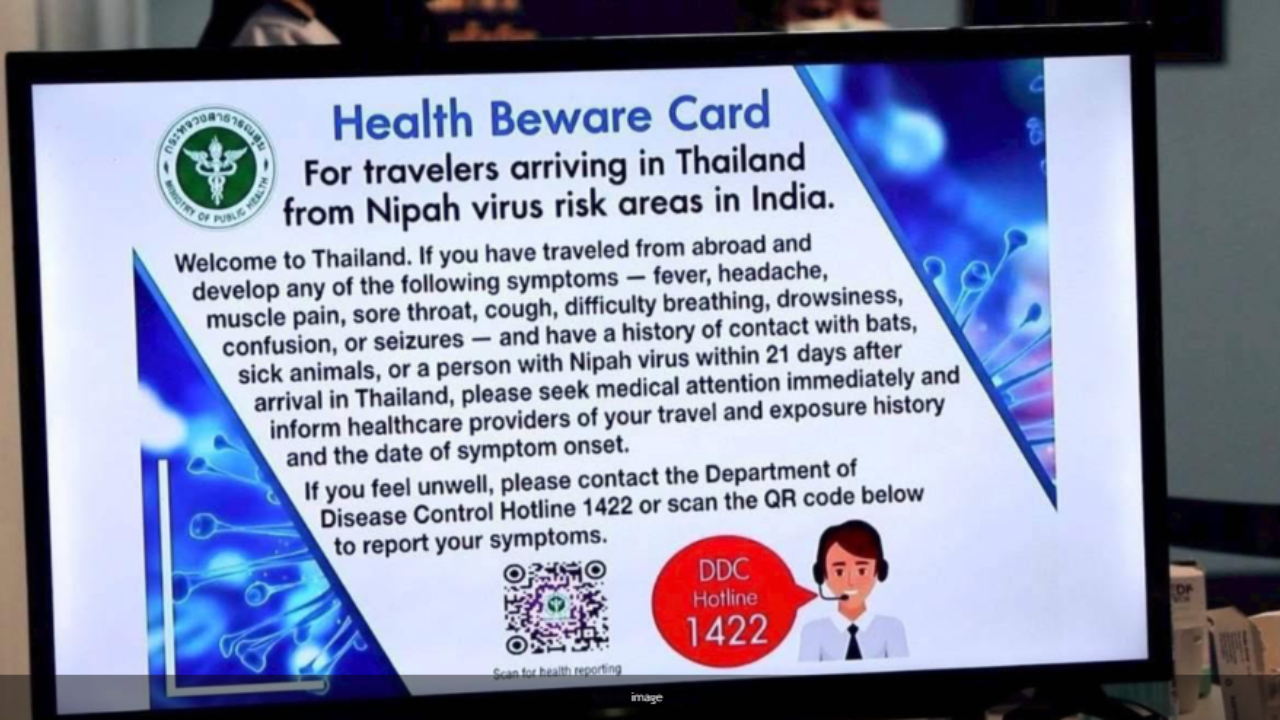
As per reports, measures such as tightened health screening and monitoring are returning to the fore as part early responses, in various parts of Asia. Thailand has begun health screenings at major airports, such as Suvarnabhumi Airport and Don Mueang International Airport and Phuket International Airport for those who are travelling from West Bengal and neighbouring areas.

thailand screening

On 25 January 2026, Thailand’s international health control checkpoints at Suvarnabhumi and Don Mueang airports started taking disease control procedures, including temperature checks and health-related documents scanning for travellers arriving from West Bengal. The screenings have gone well, the country’s Department of Disease Control said, with cooperation from passengers and the Airports of Thailand, as well as immigration authorities and other agencies.

Measures across borders

Other countries in the region are also acting on the same. Nepal has tightened entry screening at Tribhuvan International Airport and land border crossings with India to control cross-border movement, BBC reported. Also, as per a report in The Independent, Nepal, and Taiwan are among those who have taken steps like thermal screenings and health checks for passengers arriving from affected areas.

thailand screening

What is the Nipah virus?

The Nipah virus is spread from animals, especially fruit bats and pigs, to humans. It can also be transmitted by unsafe food and, in some cases, from person to person. Nipah as been placed by the World Health Organization on their list of priority diseases likely to cause outbreaks with serious public health impact.Read more: Snowfall in Kashmir disrupts air travel; all incoming and outgoing Srinagar flights cancelledThe incubation period is usually four to 14 days. Symptoms can range widely, and some people who are infected may not show symptoms. Early symptoms can include fever, headache, muscle pain, vomiting and a sore throat. In more serious cases, patients can experience diminished consciousness, drowsiness, pneumonia or encephalitis — a dangerous inflammation of the brain that can cause death. Currently, there are no approved drugs or vaccines for treatment or prophylaxis.As of last week, at least five confirmed cases had been reported in West Bengal, all traced to a private hospital in Barasat. Two of the nurses are in an intensive coronary care unit and one is still “very very” critical, local media reported, citing the state health department. So far, no cases have emerged elsewhere in the world, though precautions are spreading.


Source link